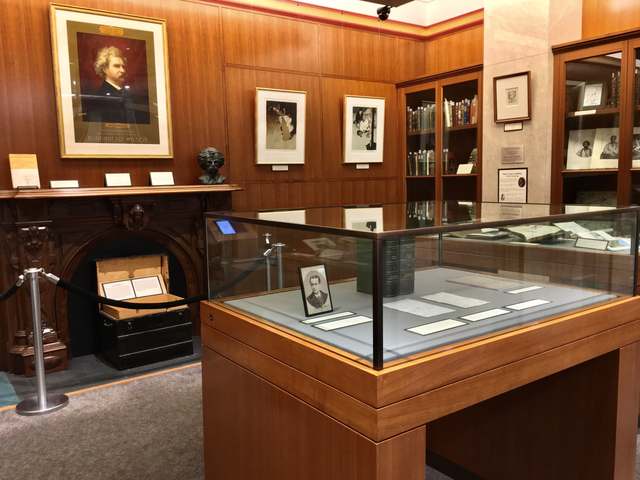
The missing pages of Adventures of Huckleberry Finn surfaced in California. Letters preserved at Berkeley helped explain their earlier journey to Buffalo. Recovering the manuscript meant rereading its paperwork, too. [1]
Buffalo's connection was not simply that a famous writer had once lived there. In 1885, library curator James Fraser Gluck asked Twain for a manuscript. The gift that followed went to the Young Men's Association Library, a predecessor of today's Buffalo and Erie County Public Library. Its catalogue records several deliveries: 487 leaves that November, another 209 around 1886, and 665 in July 1887. The last group included the beginning of the book. [2]
Where is this place?
Central Library, 1 Lafayette Square, Buffalo, New York — collection context, not the California discovery site. This map locates the town or region, not a verified exact historic event site.
That sequence matters. A library could possess a substantial manuscript without possessing all of it. Nor did a gift necessarily arrive as one tidy parcel, ready to become one tidy catalogue entry.
The receipts had something more to say
A May 1991 account in Bancroftiana describes the discovery the previous autumn: Gluck's granddaughter found the long-missing portion in a family trunk in Hollywood. The papers went to Sotheby's for examination. [1]
Two letters helped establish an earlier journey. On 5 July 1887, Buffalo Library superintendent Josephus N. Larned had acknowledged receiving the first half, sent at Twain's request. On 11 July, Gluck thanked Twain and said the complete manuscript could now be bound and exhibited. Both letters survived in the Mark Twain Papers. [1]
Bancroftiana makes an especially revealing observation: while those pages were missing, the letters had been interpreted as referring to sections of the material Buffalo already held. The discovery changed how the correspondence could be understood. [1]
The letters did not explain every subsequent movement of the leaves. There is no need to turn that gap into an accusation. The library's later catalogue records the missing portion's recovery in 1992; it also identifies material that had not previously been published. Reassembly restored more than a showpiece. It restored evidence of work in progress. [2]
A finished novel, an unfinished question
What could scholars do with that evidence? In 2001, Berkeley's Mark Twain Project described an edition drawing on the complete manuscript. Editors compared paper stocks and changes of ink and pencil to trace when different passages were written. Their reconstruction challenged the familiar claim that Twain had stopped writing immediately after Chapter 16: they concluded he had written two more chapters before that interruption. [3]
The recovered draft also preserved passages that were omitted or substantially changed before publication. A printed novel offers the version readers received. Its manuscript can expose the decisions that made that version possible. Neither is a substitute for the other. [3]
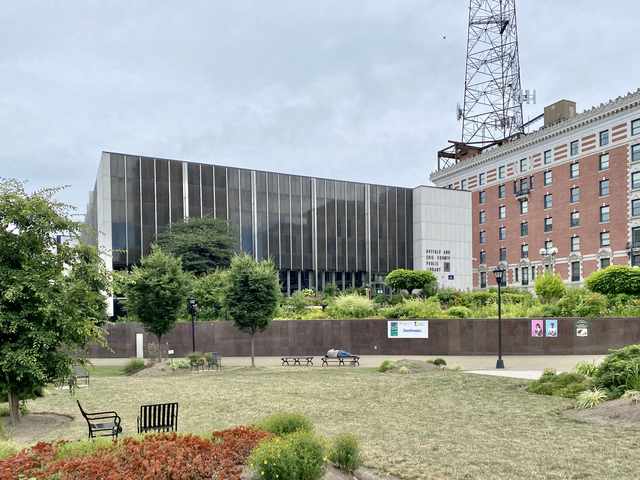
Buffalo's Central Library, at 1 Lafayette Square, houses the manuscript; its digitization was announced in 2019. The library's digital catalogue now lets readers begin with the record rather than with a legend about a miraculous attic find. [2][4]
The manuscript supplies the celebrated handwriting. The quieter letters supply something different: evidence of who sent it, where it arrived, and what the recipients intended to do next. Keeping those ordinary documents made the extraordinary object easier to understand.