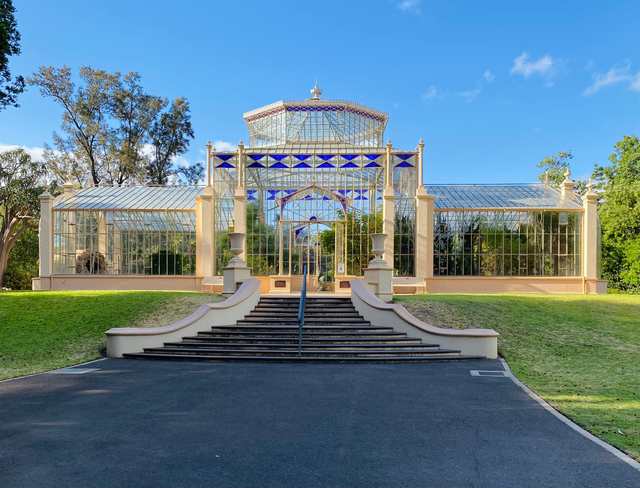
Lowering the palm by six feet had not solved the problem. By February 1893, the great plant in Adelaide Botanic Garden’s Palm House had reached the roof again. The Evening Journal reported director Maurice Holtze’s alternatives: raise the roof by ten feet or dispose of the palm. It could not be lowered any further. [1]
The plant and its enclosure wanted different things. That tension would later become a conservation problem for the whole building—not simply a question of headroom.
Where is this place?
Palm House, Adelaide Botanic Garden, South Australia, Australia — glasshouse context, not a current interior plant map or access guarantee. This map locates the town or region, not a verified exact historic event site.
Prefabricated components had arrived from Bremen in 1875, and the Palm House opened in 1877. Historian Alexander Parsons describes a coke-fired boiler beneath its artificial mound and ventilators operated by pulleys: an engineered interior for tropical plants, not just a glass shelter from the weather. [2]
Less humidity, not an empty house
By 1986, corroded iron glazing bars made the building unsafe and it closed. The restoration completed in 1995 did more than repair the enclosure. Its subsequent Madagascan planting offered a different relationship between the plants and their surroundings. The warm, dry conditions suited the new collection while reducing the demand for the humidity that had damaged the ironwork. [2][3]
The garden’s conservation account makes that double purpose explicit. Plants from south-western Madagascar receive light watering intended to meet their needs without corroding the framework. The selection comes from a particular part of Madagascar, not a miniature of the entire island. It occupies a building with needs of its own. [4]
The Friends of the Botanic Gardens’ collection leaflet describes spiny thickets, with taller trees and shrubs above a varied understorey. It also notes a conspicuous limit: the region’s baobabs are too large for the Palm House. The collection represents a landscape; it cannot fit the whole landscape beneath the glass. [5]
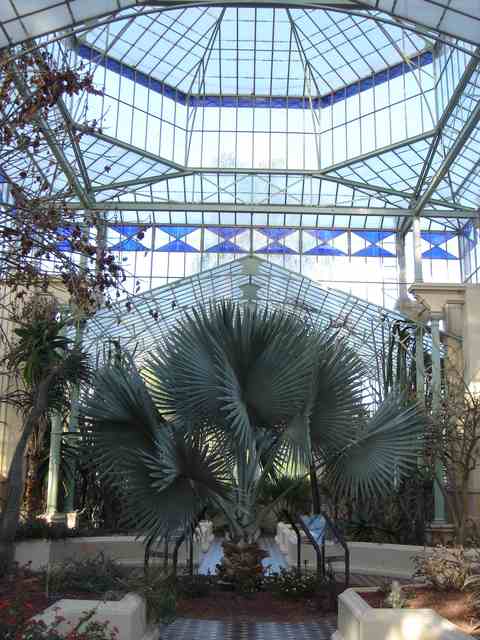
No1bone’s 2006 interior photograph shows how closely foliage and framework share the same space. A fan-leaved palm spreads below the ribs of the glass roof; other plants occupy lower beds. This is a later collection, not a photograph of the original tropical display.
Drier planting did not end maintenance. In 2018, another closure allowed treatment of salt damp and corrosion, along with pruning so light could reach smaller plants. Even a collection selected to suit the building still had to be managed as it grew. [3]
The Palm House survived with living plants inside it—but not by making the interior repeat its earliest conditions. Keeping the glasshouse meant changing what the glass enclosed.