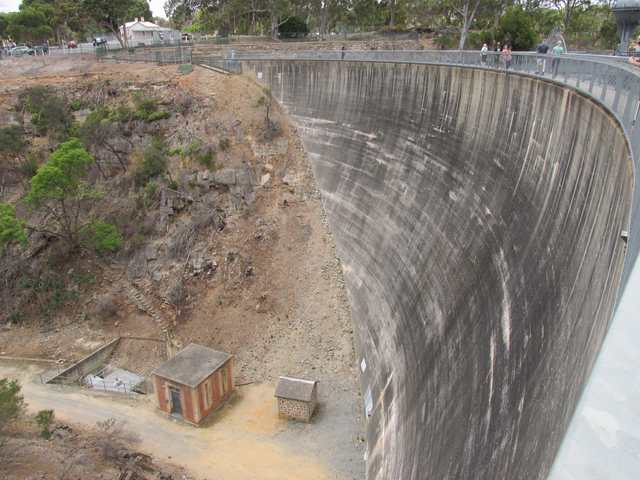
Second-hand tramrails helped reinforce the top of Barossa Dam. The Australian Academy of Technological Sciences and Engineering’s history of Australian technology records that unexpected reuse inside the concrete wall near Williamstown, South Australia. [1]
Elsewhere in the wall, the builders saved mixed concrete by including large pieces of gneiss. These inclusions were called “plums.” The academy’s account says they extended to within four metres of the crest, while the top section received the reused rails. [1]
Where is this place?
Whispering Wall, Barossa Reservoir, Williamstown, South Australia. This map locates the town or region, not a verified exact historic event site.
The dam’s better-known feature is something visitors can hear. Its curved downstream face carries quiet speech between opposite abutments, according to South Australia’s heritage register. [2] SA Water now calls the listening points Whisper Stations. A ramp leads down to them, and a walkway crosses the dam wall. [3]
The curve also had a water-storage job. SA Water describes the wall as curved against the pressure of the water it held back and dates construction to 1899–1902. [3] The academy identifies it as a thin-wall concrete arch dam. [1]
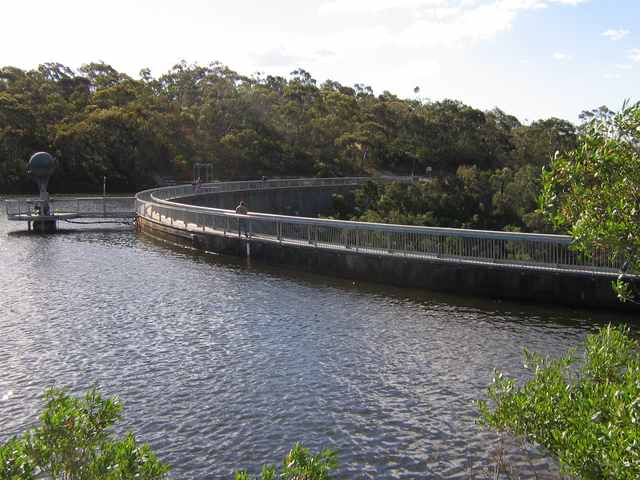
Gawler had needed a better water source. The town previously drew from a well in the South Para River; by 1897, nearby cesspools had contaminated its water, SA Water’s history explains. [3]
One part of that earlier arrangement remains outside the reservoir reserve. At the southern end of Murray Street in Gawler stands the heritage-listed pumping station built over the old well. [3]