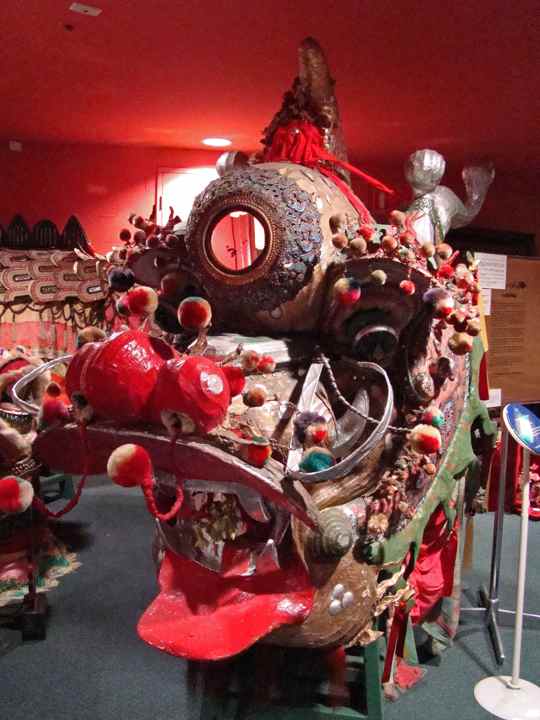
At Bendigo’s Golden Dragon Museum, Loong’s detached scales and pieces of skirt and neck fabric were kept too. A May 2022 conservation update describes specialists and students rolling and rehousing these remnants in archival boxes. His history did not stop at the edge of his assembled body. [1]
That is a quieter form of attention than a street procession. Loong had helped make Bendigo’s Easter celebrations spectacular, but his survival depended on less visible work: preparing him to parade, repairing damage afterwards and deciding what to do with material that could no longer remain attached.
Where is this place?
Golden Dragon Museum, 1–11 Bridge Street, Bendigo — geographic context. This map locates the town or region, not a verified exact historic event site.
A public life with a repair history
The town’s Easter Fair began in 1871 to raise money for its hospital and benevolent asylum. The festival’s institutional history places Loong in the parade from 1901 and records his replacement by Sun Loong in 1970. Loong was part of a local fundraising tradition, not an ornament made solely for a museum case. [2]
The University of Melbourne’s account of his conservation credits decades of care by the Bendigo Chinese Association before the larger project began. During that project, professional conservators and students worked alongside association volunteers and local conservator Jude Schahinger. Keeping Loong was already a community practice; the specialist treatment extended it. [3]
His size and fragility meant the team worked on him inside the museum rather than taking him away to a laboratory. Visitors could see the work and ask questions. The university describes students sharing techniques with volunteers who could undertake some of the time-consuming tasks. The repair process itself became something the public could encounter. [3]
Keep the remnant, remove the padding
Tape and rubber had helped carriers grip Loong’s bamboo poles; foam had cushioned their shoulders. The museum’s update records removing these additions because they might damage the original surface and were no longer needed for parade duty. Useful on the street did not necessarily mean suitable for continued display. [1]
Detached original fabric presented a different question. It could no longer do its former job, yet it could remain part of the collection.
Heritage Victoria’s account records new support stands, cleaning and the reattachment of loose decoration. It also says association members worked with the conservators to keep the treatment culturally appropriate. The goal was not simply to make a fragile object look newly manufactured. [4]
The 2012 photograph accompanying this article predates that project. Its crowded arrangement of mirrors, tufts, painted surfaces and fabric helps show why a single word such as “restoration” conceals many separate decisions. It cannot show the later treatment’s results.
A parade made Loong legible as one great moving figure. Caring for him meant looking beyond that single view.