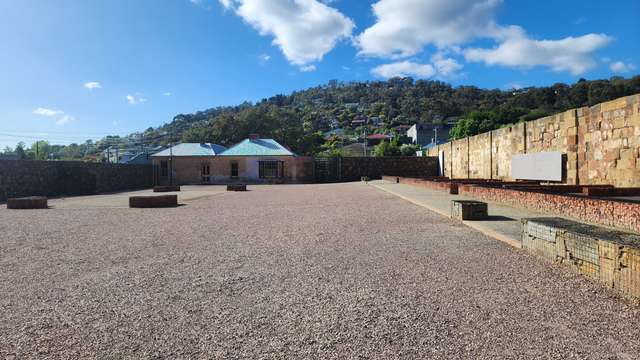
A photograph of Yard 4 at Hobart’s Cascades Female Factory shows broad gravel, stone boundary walls and a low cottage. It cannot show everything that the ground contains. Part of the nursery demolished here left evidence that survived precisely where a cleared yard might suggest absence.
The nursery was no ordinary childcare building. Yard 4 opened in 1850 within an institution that confined convict women and their children. Mothers and babies lived under a regime that separated them after weaning. Archaeology here concerns those conditions of confinement, not simply the recovery of an old building’s shape. [1]
Where is this place?
Cascades Female Factory, South Hobart, Tasmania, Australia — site context, not a nursery excavation footprint or access promise. This map locates the town or region, not a verified exact historic event site.
What demolition left behind
A 2009 Australian Heritage Council assessment summarises archaeological work undertaken in 2006. Excavators found nursery and dayroom footings, along with remains of a cookhouse, covered walkway and sub-matron’s cottage. Different drains helped distinguish successive building phases. [2]
The nursery area presented a particular surprise: demolition debris had capped deposits beneath it. Slate from the roof lay over surviving material, including bottles gathered in corners. The assessment contrasts this preservation with more disturbed deposits around the cookhouse and sub-matron’s cottage. Demolition had not treated every building alike. [2]
Nor had excavation exposed the whole nursery. The assessment describes a limited investigation; one sample covered about a fifth of the southern dayroom floor. Material from the nursery investigation was dated from around 1850 to 1911, across subsequent uses of the site. A bottle from this ground cannot automatically be assigned to a convict mother or her child. [2]
That distinction changes the story. The remains are evidence to interpret, not a complete room waiting to be uncovered—or a collection in which every object belongs to the same moment.
Finding something is not the same as keeping it exposed
Lovell Chen’s conservation management plan, first issued in 2007, recorded a practical consequence. Excavated remains in Yard 4 had been covered with geotextile and sand while decisions about their presentation were considered. Elsewhere, in Yard 3, exposed masonry was suffering from rainwater and deteriorating mortar. [3]
The plan therefore treated future display as a conservation problem: exposing more structural remains would require a design that also addressed their protection. Those observations describe the plan’s historical assessment, not a diagnosis of the site today. But they complicate an appealing assumption—that revealing more must always preserve more. [3]
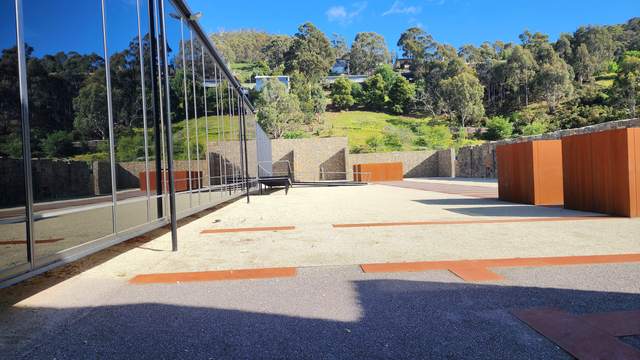
The site’s operator now distinguishes another kind of visibility. Some archaeological objects are displayed at Cascades; the rest of the collection is held at a facility at Port Arthur. That statement concerns the collection generally, not the whereabouts of each nursery find. [4]
An open yard is not necessarily an empty record. At Cascades, understanding what disappeared also means asking what survived below it, how much was investigated, and when keeping evidence safe means leaving it out of sight.