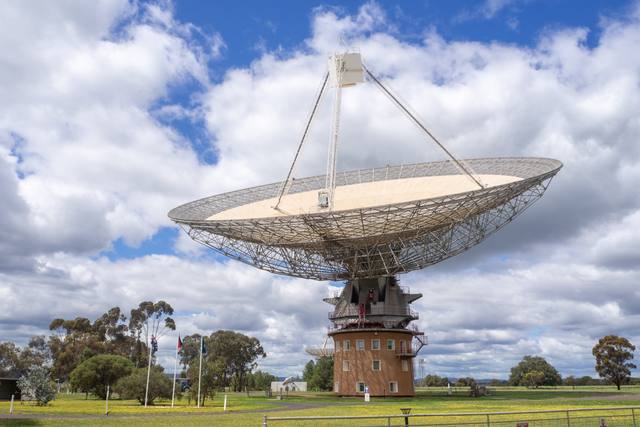
The great dish at Parkes looks like a machine built to listen far beyond its own paddock. Its 64-metre span dominates Maksym Kozlenko’s 2020 photograph. CSIRO says low radio interference helped determine the site. Yet learning what the telescope was hearing sometimes required paying closer attention to its neighbours. [1]
The mystery was already local
In 2015, astronomer Emily Petroff explained why the strange pulses called perytons were not a story about scientists mistaking lunch for aliens. They appeared across all thirteen beams of the receiver, rather than in the pattern expected from a distant point in the sky. Their terrestrial origin was already clear; the particular source was not. [2]
Where is this place?
Murriyang, Parkes Observatory, New South Wales, Australia — observatory context, not office or kitchen directions. This map locates the town or region, not a verified exact historic event site.
Three new events in January 2015 became useful because software found each within a day. Researchers could compare them with records from an interference monitor installed the previous December. At the same moments, that separate instrument had detected emission around 2.5 gigahertz—outside the frequency range then being observed with the telescope. The extra listening device supplied a missing clue. [2]
The team’s research abstract describes the eventual result: opening a microwave oven before its cycle finished could produce a peryton when the telescope was at a suitable angle. Emission during the magnetron’s shutdown explained the signals. The same abstract explicitly distinguishes them from FRB 010724, a fast radio burst that the site’s ovens could not explain. [3]
Petroff’s account says ordinary microwave operation had not reproduced the pulses. The successful test changed the stopping procedure. What mattered was not merely discovering an appliance nearby, but reproducing the signal under particular conditions. [2][3]
A solved mystery was not a quiet site
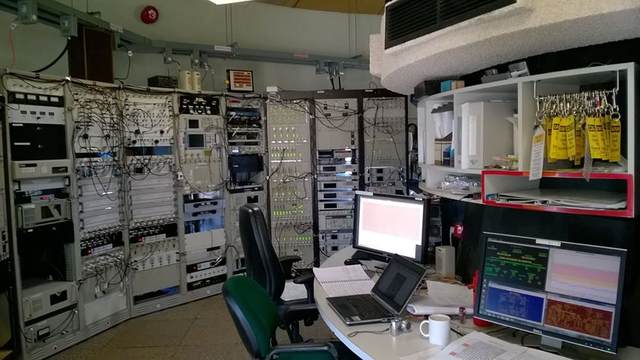
A later study shows why that distinction still matters. Tommy Marshman and colleagues’ 2026 paper examined Wi-Fi and Bluetooth interference around the telescope, now named Murriyang. They compared ways to recover astronomical information rather than discard a heavily affected section of the observing band. [1][4]
Their test used ten seconds of data recorded while observing the Vela pulsar on 10 August 2023. Removing contaminated samples made its pulse usable. But the authors cautioned that settings suitable for pulsars could remove brighter astronomical events; a filter was not a universal rule for deciding what belonged to Earth. [4]
The paper also said the proposed new methods had not yet been installed in the live observing system. That was the status of the published study, not a claim about every subsequent upgrade. At Parkes, solving the kitchen mystery had not finished the larger task: separating an astronomical signal from the ordinary radio activity around it. [4]