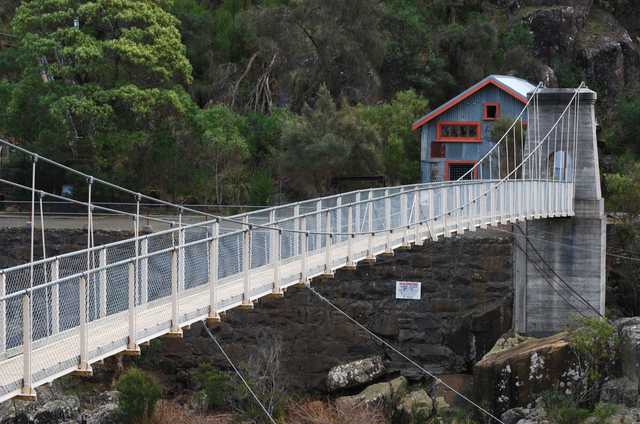
A suspension footbridge makes Duck Reach look approachable. In a 2008 photograph, its pale deck runs across the South Esk River toward a steep, wooded bank. But a route for visitors is not necessarily a delivery route for a power station’s machinery.
That difficulty survived the change from electricity generation to heritage display. The City of Launceston identifies the former station, completed in 1895, as an interpretation centre. Preserving what happened inside it has required more than preserving a building. [1]
Where is this place?
Duck Reach Power Station, South Esk River, Launceston, Tasmania, Australia — site context, not delivery or walking directions. This map locates the town or region, not a verified exact historic event site.
Small enough to fly
Glasgow Engineering’s account of conservation work after the June 2016 flood describes a demanding list: repair the flying fox—a cable-suspended carriage—make a cable-termination tower, repair the support structure for a water pipe and reinstate an old hydro turbine. Components had to travel in and out by helicopter. A machine built to stay put beside a river first had to become transportable. [2]
The contractor’s photograph captions make that practical problem unusually clear. The turbine was dismantled into loads with a target of about 750 kilograms per item, flown in and reassembled in the powerhouse. That figure describes a transport goal, not the weight of the complete turbine or a general helicopter load limit. [2]
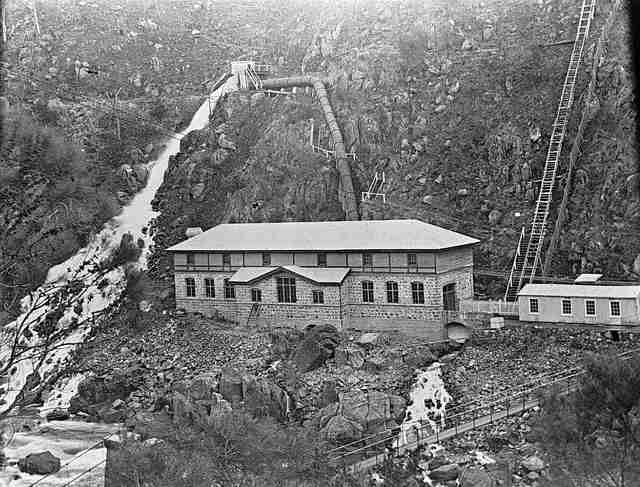
An older view in Museums Victoria’s collection shows why the setting matters. Catalogued as circa 1900 and credited to Trethewie, it places the long powerhouse beneath a rocky slope, with steps climbing the cliff and a suspension bridge below. It is a record of the working site’s arrangement, not a photograph of the helicopter work. [3]
Returning did not mean restarting
Engineering heritage chair Bruce Cole’s account, published online in April 2024 from a March 2023 article, describes a small 12-kilowatt machine brought back from the Waddamana Museum by helicopter. Cutaway casings let visitors see inside it. A returned machine could explain electricity without supplying the city again. [4]
Cole also described plans for a larger turbine and alternator: dismantling them into lighter parts, building a five-tonne cableway and fitting them onto surviving original holding-down bolts. He identified the lack of road access as a major difficulty. Those plans belong to that dated account; they are not evidence here that every proposed installation or return to generation subsequently happened. [4]
At Duck Reach, moving an exhibit was part of conserving it. The bridge, the old photograph and the repair accounts tell different parts of that story: keeping machinery in its original setting can require taking it apart somewhere else first. [2][4]