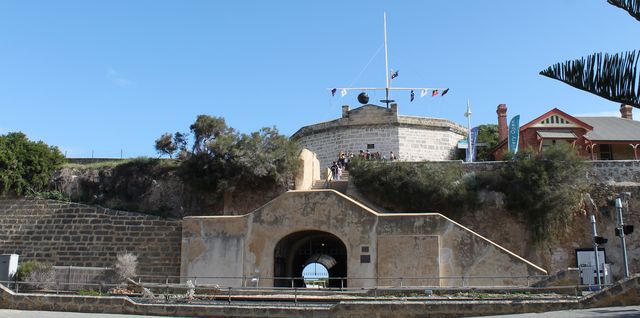
Before Fremantle’s new tunnel canopy reached Bathers Beach, its steel spent eight weeks weathering off-site. The arched structure, completed in 2022, extended out from Whalers Tunnel beneath Arthur Head. Inside were hydraulic impact buffers; cut into the steel were a whale and a European whaling ship. [1][4]
The passage had begun with a request from the Fremantle Whaling Company in 1837. The company wanted a route through Arthur Head, beneath the Round House gaol, linking its beach operations with High Street. The heritage register records that it paid for the work and that civil engineer Henry Willey Reveley directed it. A later Heritage Council account dates completion to January 1838. [2][3]
Where is this place?
Whalers Tunnel, Arthur Head, Fremantle — historical site context, not a current access or safety assurance. This map locates the town or region, not a verified exact historic event site.
The headland is part of Manjaree, a Whadjuk Noongar meeting and trading place. The Round House also held Aboriginal prisoners before their transfer to Wadjemup, or Rottnest Island. Those histories formed part of the setting artist Jo Darbyshire was asked to consider when designing an artwork for the new rockfall canopy. [3][4]
Darbyshire’s first-person account identifies the permission behind her whale design. Whadjuk Noongar Elder Noel Nannup had shared a story with the community at Bathers Beach in 2017; she says he allowed her to use it for this project. Her images were laser-cut into the weathered Corten steel. The canopy was installed as part of work to reinforce the tunnel entrance and stabilise the cliffs above. [1][4]
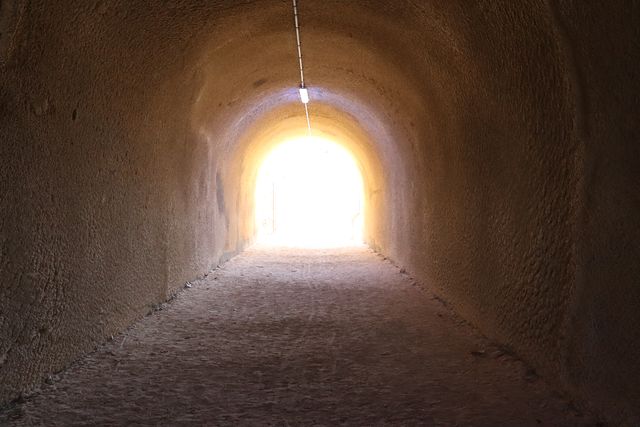
The artwork also needed historical text and drawings a fabricator could use. Darbyshire credits Anne Brake for their work on the European history of the tunnel, and local artist Rick Vermey for the computer-aided design drawings. [4]