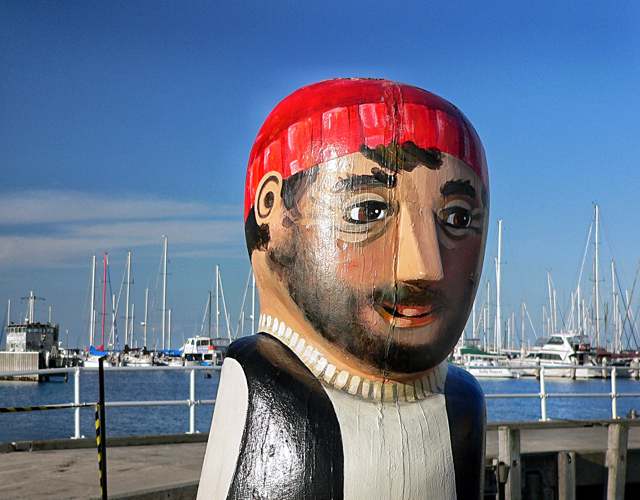
A painted face can hide a post without quite disguising the wood. In Bernard Spragg’s 2005 photograph of a Geelong waterfront figure, lines in the timber run through its cap, forehead and cheek. The character has eyebrows, a beard and a large projecting nose, but its old material remains part of the portrait.
That relationship is now being tested. On 2 October 2026, the City of Greater Geelong announced a fibreglass version of Jan Mitchell’s Early Geelong Footballer at Eastern Beach Road and Bellerine Street, with a separate 3D-printed prototype and test pieces for display at Wurriki Nyal. These were concepts for public consideration, not an announcement that the whole collection had been replaced. [1]
Where is this place?
Geelong waterfront, Victoria — geographic context for the bollard collection, not an exact prototype-access guide. This map locates the town or region, not a verified exact historic event site.
The timber already had a previous life
Mitchell’s figures began with recovered wharf pylons. The city’s account of her career traces the idea from an artist-in-schools project at Barwon Heads to a proposal she took to Geelong’s commissioners in 1994. By 1999, more than a hundred painted characters stood along the foreshore. [2]
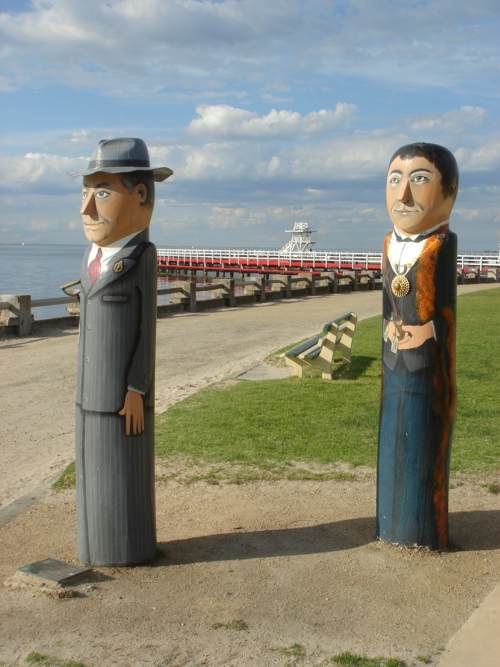
The renewal announcement identifies the former Yarra Street Pier as the source of the reclaimed timbers. That gives the sculptures two local histories: the people painted on them, and the waterfront structures their wood once supported. It also explains why replacing a figure involves more than finding a fresh surface for its coat. [1]
These are playful interpretations, not a row of documentary portraits. Consider the Volunteer Rifle Band. The city’s artwork guide connects the group to musicians who entertained picnickers at the Botanic Gardens. Yet it says the painted music is The Frozen Fountain Polka, substituted because the local Geelong score was lost. A joke and a missing document occupy the same little scene. [3]
Keeping the grain without keeping the timber
In its renewal consultation, the city says digital photography and 3D scanning have recorded details of the original bollards, including irregularities in their wooden surfaces. The aim is to carry recognisable shapes and personalities into replacements, even when the material changes. The same account acknowledges that decades of repainting and conservation have already produced variations in colour and finish. There is no simple, untouched version of the entire collection to return to. [4]
The proposed first-year group includes the Volunteer Rifle Band. Other originals are to continue receiving maintenance, and the city cautions that priorities may change as their condition changes. Its consultation describes a staged programme, not a single overnight substitution. These are the collection owner’s plans and assessments, rather than an independent forecast of how long any new material will last. [4]
The photographs here predate this project. They show the older wooden characters, not the new footballer prototype, and cannot diagnose their condition today.
Geelong’s question is unusually concrete: should a familiar face retain its old wood, its old shape, its painted details—or as much of each as care can preserve? A pylon once carried a pier. After Mitchell, it carried a character. The next version may carry the texture of that pylon without carrying the timber itself.