A woody pear from Sydney’s Hyde Park Barracks bears an unusually helpful mark: its botanical name, written in ink. It is an object with a label but no identifiable label-maker. In a collection studied for evidence of eating, it also sets a useful trap. This pear was not edible. [1]
The distinction matters at a building whose floors preserved so much that official accounts left out. In her 2025 study, archaeologist Kimberley G. Connor examined dried plant remains from the barracks’ underfloor collection. Fruit stones, nut shells and peel offered evidence of food beyond the institutions’ recorded meals. But the inked specimen was a reminder that finding a plant in a lived-in building is not the same as finding somebody’s lunch. [1]
Where is this place?
Hyde Park Barracks, Macquarie Street, Sydney — public museum location, not the exact find spot or artefact storage location. This map locates the town or region, not a verified exact historic event site.
A fruit, but not that kind of pear
The name is Xylomelum pyriforme. New South Wales Flora Online lists it as a shrub or small tree in the Proteaceae family. Its account of the genus describes a woody, pear-shaped fruit called a follicle, containing two winged seeds. “Pear” describes a resemblance; it does not turn the specimen into the familiar soft fruit. These botanical references describe the plant, not the history of this particular object. [2][3]
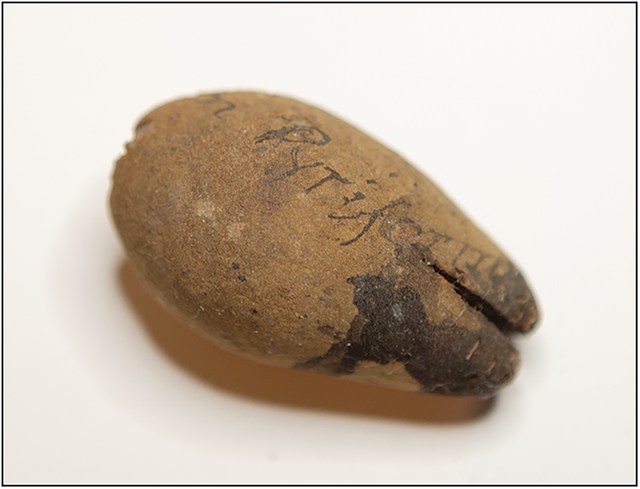
Connor’s published photograph shows the ink across the brown surface. Her caption gives the specimen’s length as approximately 50 millimetres. She cannot identify the person who wrote the name. That uncertainty rules out an appealing but invented scene: a particular resident collecting it, consulting a book, or showing it to a friend. The mark survives; the conversation, if there was one, does not. [1]
A floor is not a filing system
The barracks housed a Female Immigration Depot from 1848 to 1887 and a Destitute Asylum from 1862 to 1886. Their uses overlapped. Excavations during the building’s conversion to a museum in 1980–81 recovered material protected by the dry spaces beneath the floorboards. Yet those spaces did not preserve a neatly ordered sequence of occupants. [1]
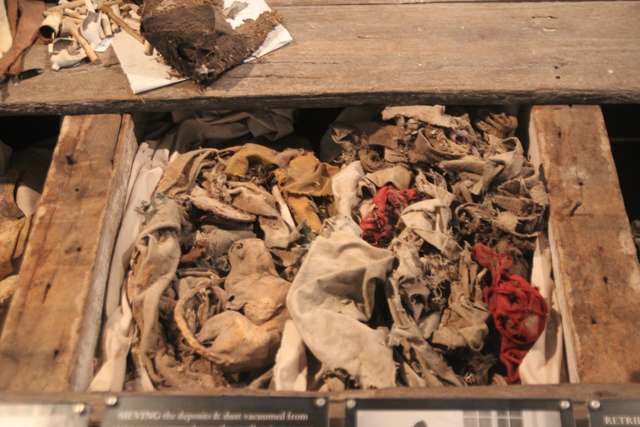
Connor describes deposits assembled through several processes: things fell or were swept through gaps, people concealed objects or disposed of waste, and rodents moved material. The deposits have no stratigraphy—a sequence of layers that would separate their contents chronologically. A modern photograph of the museum display helps convey the jumble, but cannot tell us how each visible object arrived there. [1]
That makes the ink especially arresting. Unlike a shell whose presence might be explained by a snack, the woody pear carries direct evidence that someone named a plant. It does not reveal who, when or why. Reading it responsibly means holding onto both parts: a deliberate mark and an incomplete biography.
At Hyde Park Barracks, the remains of daily life do more than fill gaps in a menu. They can challenge the category of evidence itself. One object in a study of food asks us to stop looking for what was eaten—and notice what was written.