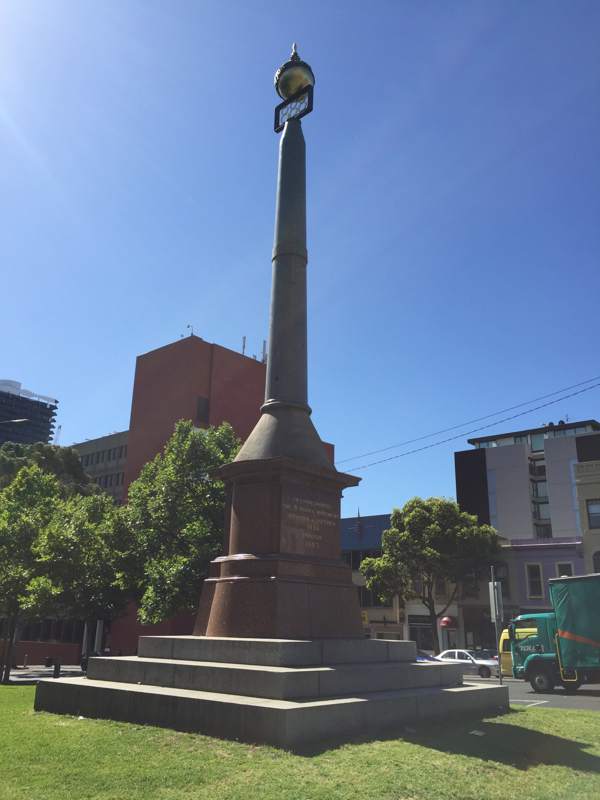
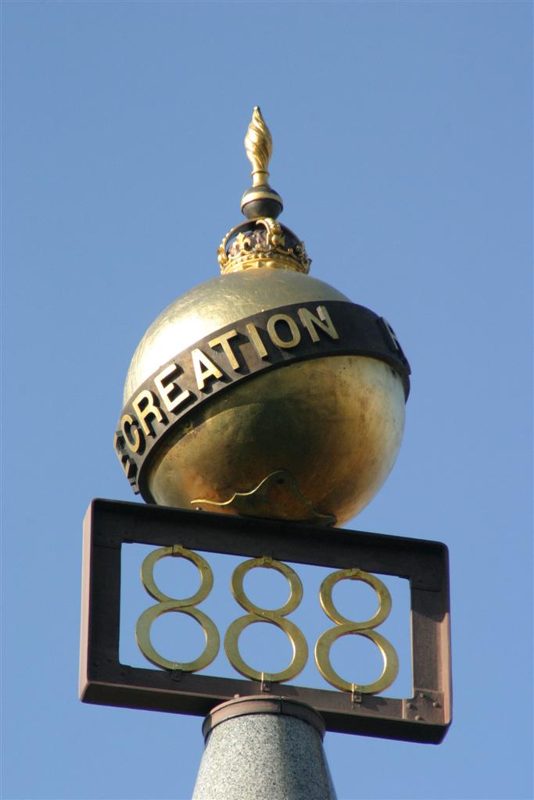
Melbourne’s Eight Hour Monument makes its point without a statue of a worker. In Mattinbgn’s November 2014 photograph, a tall column carries three eights beneath a globe. Scott Sandars’s closer photograph shows the word “Recreation” wrapped around that globe. The working day has become a diagram of how a whole day might be divided.
That was not the only design imagined for the site. Historian Maryanne McCubbin describes Percival Ball’s original scheme as a workman beside the goddess Liberty, who held a torch. The eventual monument reduced that figurative company to a column, numbers and a globe. [1]
Where is this place?
Eight Hour Monument, Melbourne — geographic context, not a current demonstration route or event schedule. This map locates the town or region, not a verified exact historic event site.
The people who stayed in the proposal
The memorial was a later act of commemoration, not an object erected during the 1856 campaign. McCubbin records the laying of its foundation stone in April 1891, followed by years of delay. After Ball’s death in 1900, she writes, the organising committee reworked the design into a less expensive form. The monument was unveiled on 21 April 1903. [1]
Victorian Trades Hall Council’s 2019 interpretation offers a useful counterpart. Discussing the original model, it says the scheme proved too costly for its working-class supporters. This is evidence of an ambition constrained by fundraising—not proof that the organisers decided human figures were ideologically unsuitable. [2]
The design attribution needs care. The Victorian Heritage Register’s account credits Ball with creating a simpler version early in the twentieth century; McCubbin instead describes the committee’s work after his death. These are not interchangeable accounts of who did what. The secure distinction is between Ball’s original figurative proposal and the reduced monument completed in 1903. [1][3]
Three eights were already a public language
The numbers stood for eight hours of labour, eight of rest and eight of recreation. The register describes both the monument’s inscription and its intended role as a focal point for the movement’s annual procession. A compact symbol could connect a permanent object with an event that repeatedly passed through the city. [3]
Trades Hall’s account makes clear how much organisation the celebration required. Its committee coordinated individual unions’ floats and displays, then arranged sports, games and other attractions. Commemoration involved deciding what would move through the streets and what people would do together afterwards—not simply remembering a date. [2]
The slogan should not be mistaken for a universal settlement. The National Museum of Australia explains that the initial gains mainly benefited a minority in the building trades; most workers, including women and children, continued to work longer hours. The monument celebrates an achievement whose reach still had to be extended. [4]
A place for people, even without their statues
The monument also changed address, moving from the vicinity of Parliament House to the corner opposite Trades Hall in the early 1920s. Published accounts differ over the precise year. Heritage Victoria’s 2023 overview nevertheless describes its continuing importance as a meeting place for the union movement. That is the agency’s dated account, not a calendar of present-day gatherings. [1][3][5]
Neither photograph here shows the unbuilt model or the original Spring Street setting. Together they show what the revised design made visible: a large civic marker and a small, easily read allocation of time. The planned workman and goddess never became the finished monument’s figures. The people who gathered around it gave the simpler structure a different kind of human presence.