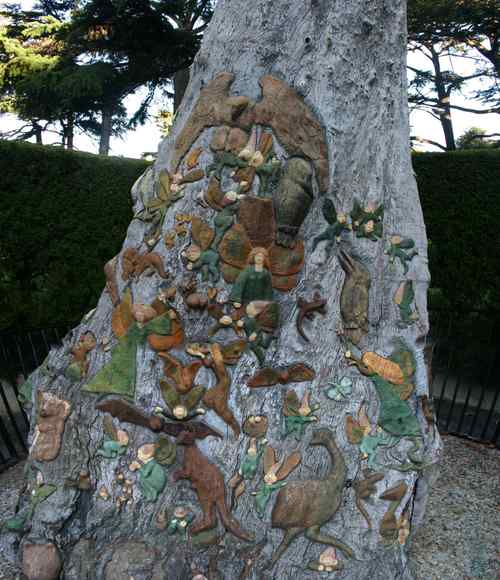
The koalas in Doug butler’s April 2023 photograph appear to cling to a tree trunk. Around them, painted figures occupy the grooves and hollows of the wood. The cracks belong to the same surface as the creatures: this is not a collection of toys placed among living branches.
Ola Cohn began with a dead River Red Gum, carving and painting it between 1931 and 1934. That sequence is explicit in the account of International Conservation Services, a later conservator for the City of Melbourne. [1]
Where is this place?
Fairies Tree, Fitzroy Gardens, Melbourne — geographic context, not a current access or condition guide. This map locates the town or region, not a verified exact historic event site.
A public work, before it was finished
Cohn’s project in Fitzroy Gardens became a spectacle while she was still making it. In his National Gallery of Victoria essay, curator Ted Gott describes the artist carving Australian animals and fairy figures from May 1931. He reproduces a November 1932 Riverine Herald account of children gathering to ask questions about the emerging characters. In that report, explanations grew into a fairy story. [2]
That is a historical account of an audience’s response, not a transcript of conversations preserved here. It nevertheless changes how the finished object can be understood. The trunk offered figures to look at; the work in progress also prompted people to ask who those figures were.
The National Trust’s heritage assessment records two related books: The Fairies Tree, around 1932, and More About the Fairies Tree, in 1933. It credits the books with helping the work reach a wider audience. The sculpture’s public life extended beyond the people standing in front of it. [3]
A dead tree cannot repair itself
ICS reports that the trunk was lifted from the ground in the late 1970s. Decayed wood was removed before it was mounted on concrete. Preservation required changing how the sculpture met the ground. [1]
ICS describes monitoring from 2012 and recurring problems with wood, decorative surfaces and paint. Its treatments include securing loose fragments, reconstructing some missing decorative elements and painting repairs. The visible work cannot simply be assumed to consist entirely of untouched 1930s material. [1]
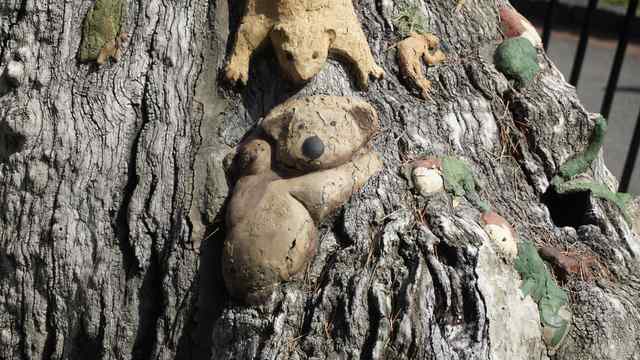
Nor are the photographs here a controlled record of treatment. Takver’s April 2005 view shows a broad face of the carved trunk; Doug butler’s 2023 detail concentrates on a smaller group of animals and figures. Different dates and viewpoints cannot, by themselves, tell us which repairs happened between them.
The heritage assessment gives the work’s sentimental importance a place alongside its physical vulnerability. It treats public attachment as a reason to preserve an object exposed to the weather—not as a guarantee that the wood will last indefinitely. [3]
The tree cannot grow its way out of damage. Its carved world persists through care for the wood, paint and small details that make it readable.