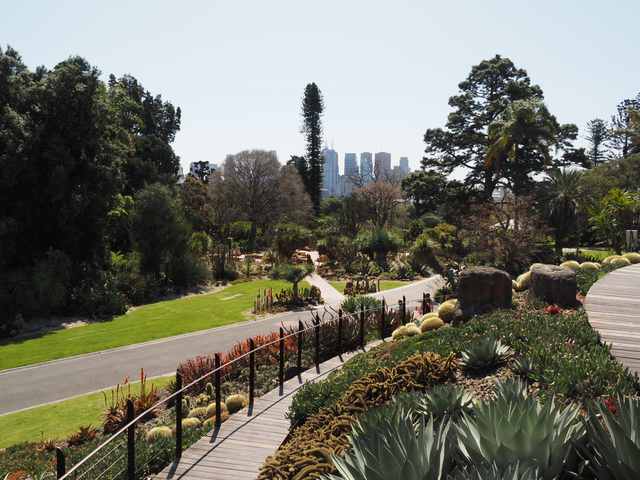
The upright rock at Guilfoyle’s Volcano was meant to look as though an eruption had thrown it into place. Andrew Laidlaw, the landscape architect behind the Melbourne garden’s revival, said so in a 2011 Gardening Australia interview. The rock was theatre. The reservoir inside the hill was not. [1]
Laidlaw also explained what the project was not: an exact replication of William Guilfoyle’s planting ideas. There was not enough documentation for that. Instead, he used living plants and hard surfaces to suggest an eruption—a new composition around an old piece of water infrastructure. [1]
Where is this place?
Guilfoyle’s Volcano, Royal Botanic Gardens Melbourne — landscape context, not access or route guidance. This map locates the town or region, not a verified exact historic event site.
A reservoir with a landscape around it
The Royal Botanic Gardens’ 2022–2042 Living Collections Plan dates the bluestone-lined reservoir to 1876. It occupied the Gardens’ highest point, near Anderson Street, and originally held water pumped from the Yarra for irrigation. Its volcanic form made a practical structure part of the surrounding scenery. [2]
The same plan records the area’s later neglect and its revitalisation in 2010, when the reservoir and landscape became the first stage of the Working Wetlands project. That was not simply a decision to make an abandoned feature picturesque again. Water was part of the return. [2]
Laidlaw’s account helps distinguish restoration from reconstruction. Low-growing succulents suggested spreading lava, while taller plants and upright rocks gave the scene contrasting shapes. He described using the surrounding lawns and bold foliage to connect the project to the larger garden, rather than treating the cone as a separate exhibit. [1]
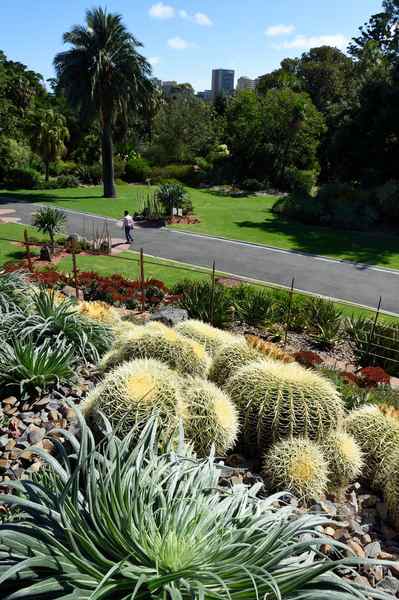
The result asked visitors to recognise a volcanic idea, not to believe that every plant had been recovered from a nineteenth-century plan.
A living design met actual weather
Before the revived feature opened, Melbourne supplied a less theatrical disturbance. The Friends of the Royal Botanic Gardens’ Winter 2010 magazine records the severe hailstorm of March 6. New planting at the Volcano was hit hard. The account says it was already recovering; the Friends’ president also thanked staff whose storm cleanup helped the feature look ready for its March 31 opening. [3]
The issue’s construction photographs show another transformation: the emptied reservoir, the installation of biofilter discs, then water and plants growing on the floating units. Its accompanying account describes water from the Ornamental Lake returning to the reservoir for irrigation. These are records of the project taking shape, not measurements of how effectively it treated water. [3]
That distinction matters in a place whose engineering can resemble a garden ornament. A floating island may contribute to a carefully arranged view while also having a job to do.
What the later plan asks gardeners to keep
The Living Collections Plan describes the renewed reservoir as part of the Gardens’ water-recirculation and treatment system. It also identifies a less mechanical continuity: repeated succulent specimens create a rhythm around the cone and reinforce its circular form. Keeping those key plants is part of maintaining the design. [2]
The plan is therefore not merely a list of unusual things growing in one corner of Melbourne. It records a composition that has to remain alive, alongside a working reservoir. The old feature could return without pretending that its original planting scheme was fully known. What continues is a relationship between water, plants and an invented eruption—not a garden frozen at one moment.