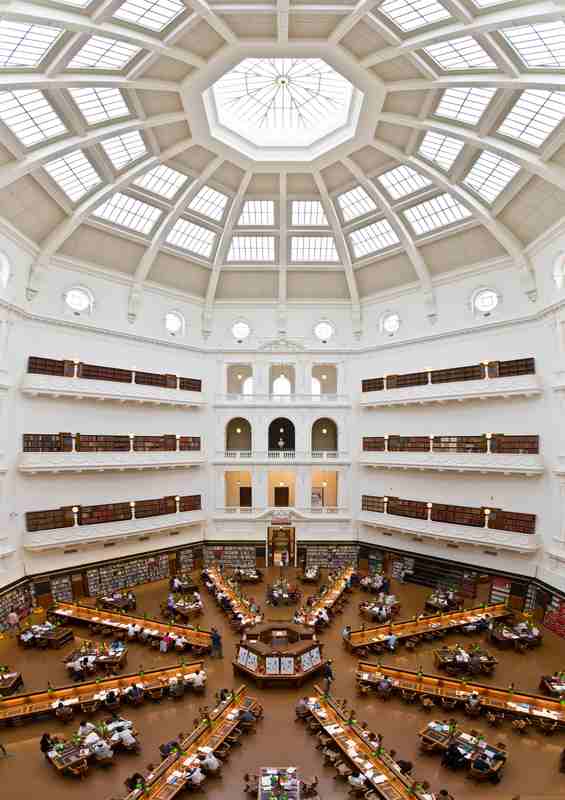
Some of the words around Melbourne’s La Trobe Reading Room occupy space that once held books. During the refurbishment completed in 2003, panels of quotations went into the wall zone above the perimeter shelves. Architect Phil Baigent explained that the former high shelving had become inaccessible under safety requirements. A practical subtraction created room for a different kind of reading. [1]
The room itself was much older. State Library Victoria’s history dates its opening to November 1913 and its reopening, with the La Trobe name, to July 2003. The quotations belong to that later intervention, not to the original decorative scheme. [2]
Where is this place?
State Library Victoria, Melbourne — geographic context, not current gallery access or opening-hours guidance. This map locates the town or region, not a verified exact historic event site.
Beautiful did not always mean easy to use
An October 1970 article in the library’s journal reproduced former staff member Leigh Scott’s recollections of the building. He remembered readers needing ladders to reach high shelves, and staff being called to help. The same article reproduced a Library Council report criticising slow retrieval from the stacks and long walks around the surrounding floors. [3]
These are dated assessments of how the building worked, not a verdict on present-day service. They also describe two distinct problems: reaching books on the reading-room walls and fetching books from storage elsewhere. Neither should be collapsed into a claim that the refurbishment removed all the library’s books.
Baigent’s June 2003 account explains the physical solution for the quotations. The new panels were attached over the existing bookshelf supports, as an addition designed to be distinguishable from the old fabric. Their incised letters became visible through light and shadow. Daylight from the restored skylights lit the lettering from above; artificial lighting took over at night. [1]
The setting mattered. DAVID ILIFF’s panorama, made from photographs taken in October 2005, shows the desks, shelves and galleries as parts of one large interior. BindiS’s August 2025 photograph looks upward toward the glazing. Neither image is a close-up transcription of the wall panels or a photograph of the earlier high shelves.
An editorial job, not a hunt for attractive sayings
Cathrine Harboe-Ree, who led the selection of the words, described the process in the same 2003 journal issue. She and State Librarian Frances Awcock began discussing the idea in 1998. An early collection grew to hundreds of quotations; the completed installation contained 38. [4]
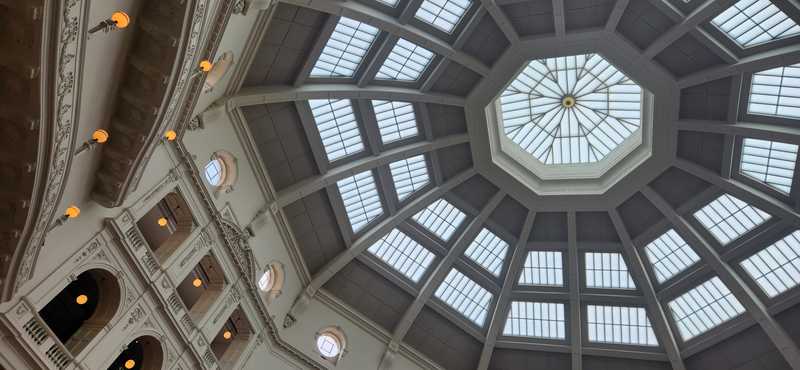
Selection was only the beginning. Harboe-Ree’s account describes editors checking originals, deciding which editions and translations to use, and seeking permission where appropriate. A passage attributed to James Joyce turned out to join two pieces separated in the novel. A Borges selection required a choice between translations. The finished lettering concealed a substantial amount of bibliographical work. [4]
Editor Beth Dolan checked the final artwork before the words were cut into the panels, when correcting mistakes would become much harder. Harboe-Ree and editor Bev Roberts had treated the combined selection as a book: individual passages needed to work together, not merely fill available wall space. [4]
That connects the lettering to the shelves beneath it. One part of the refurbishment changed what readers could physically reach. Another asked what a library should place before their eyes. The room did not simply exchange books for decoration; it gave editing a visible architectural form.