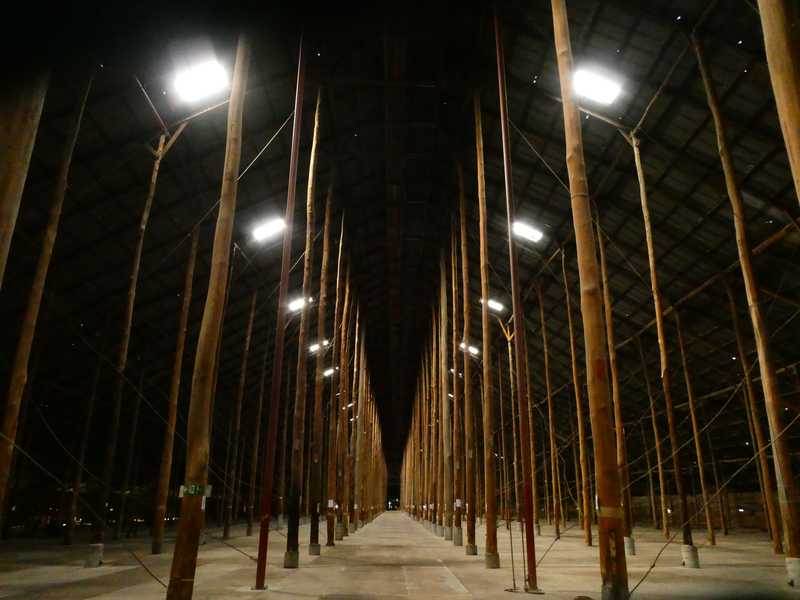
A building famous for its forest of poles could not be preserved simply by leaving every part alone. Barpa lists November 2025 as the completion date for a repair project at Murtoa’s Stick Shed. The contractor reports replacing a failed structural post, alongside repairs to timber, joints, rafters and supports for the old grain conveyor. [1]
The work was not intended to make the shed store wheat again. The former grain store had become a place people came to see—and, according to the contractor, those visitors continued to arrive while repairs were under way.
Where is this place?
Murtoa Stick Shed, Victoria — named heritage site, not a route through the working grain terminal. This map locates the town or region, not a verified exact historic event site.
That is the less obvious story behind the enormous interior: keeping the building has meant changing both its parts and its job.
Built for grain that could not leave
The shed began as an answer to a wartime storage problem. Overseas trade had been disrupted, leaving Australian wheat needing somewhere to wait. Construction at Murtoa began in late 1941 and the store was completed in 1942. The national heritage account describes how shortages of steel encouraged builders to use unmilled hardwood poles and adapt familiar rural construction techniques. [2]
The timber was not merely a picturesque choice. It was part of getting a large, practical building erected with available materials.
The operator’s history explains the machinery that gave the space its purpose. Grain travelled up an elevator and along a high central conveyor. Timber bulkheads resisted the sideways pressure of the stored wheat; another conveyor helped take it out again. Power changed over the years, from steam to diesel and then electricity. Even while it was a grain store, the shed was not an untouched original. [3]
An empty building, a contested piece of ground
By the end of the 1980s, the operator’s account says, the old arrangement no longer suited the industry. Buyers wanted wheat separated by quality; the shed’s great shared pile did not provide that separation. Its history dates the final emptying to 1990, when the remaining grain was taken away by rail. [4]
The ground beneath the building was still useful. The same account describes competing demands: space for more efficient grain handling, or retention of the shed as local heritage. A preservation campaign was therefore not just a request to admire an old roof. It argued for keeping a building on land that had another possible job. [4]
The Wimmera Stories collection records an interim preservation order in December 1989 and entry on the state’s historic buildings register by December 1990. It also describes later stabilisation work, including damaged-pole repairs and wire netting across the roof area. Protection on paper and physical repair were separate achievements. [5]
A museum with a work zone
On 17 September 2025, the Stick Shed announced another maintenance program, due to run from late September into November. Some areas would be cordoned off and displays moved into parts remaining open. The announcement included pole replacement among the coming tasks. It was a plan, not a completion report. [6]
Barpa’s later project account supplies a different kind of evidence: the contractor reports completing the repairs in November, with active work areas isolated while the broader facility remained accessible. That is the company’s account of its work, not an independent structural inspection or a statement about access today. [1]
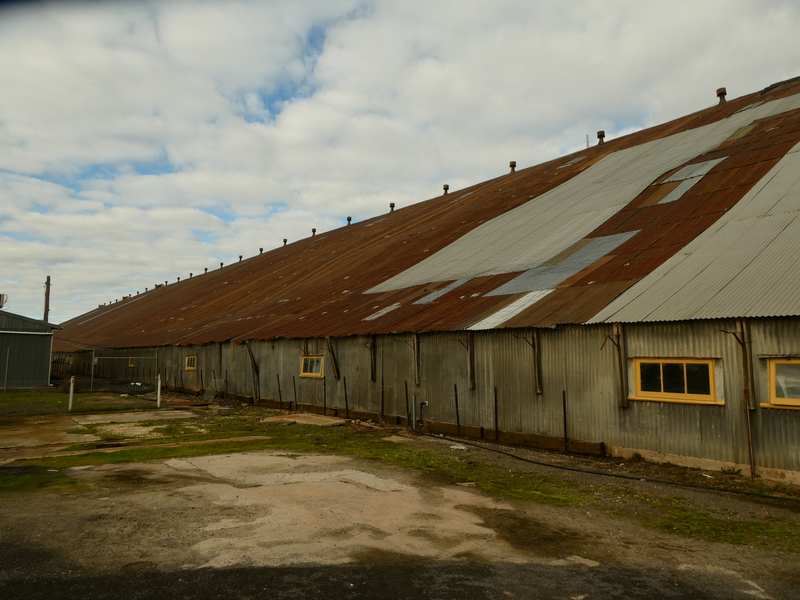
The two photographs here were taken in July 2023, before that project. They show the long corrugated exterior and the rows of poles inside, not the outcome of the 2025 repairs.
Murtoa preserved the space where grain once waited. It did not preserve a rule that nothing could change. The shed’s second life has depended on people being willing to repair a part, move a display and keep the larger building useful.