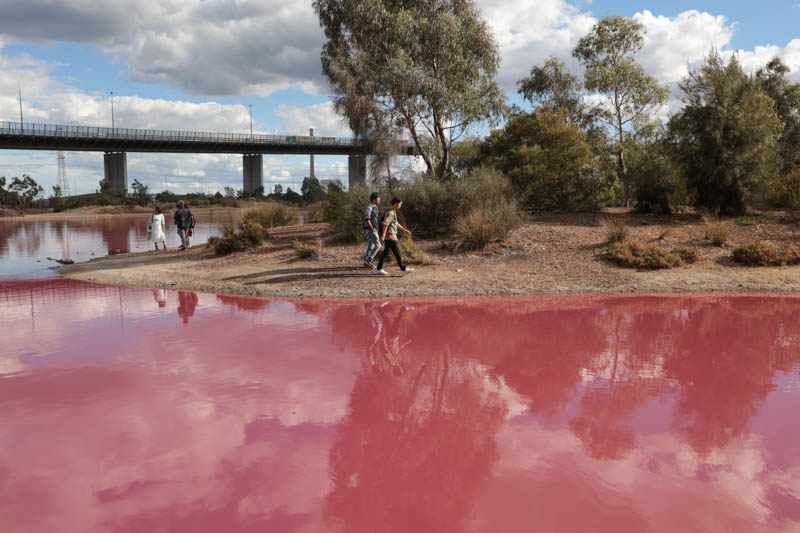
The photograph is almost too neat: a pink lake beneath Melbourne’s West Gate Bridge, a landscape whose colour appears to explain why anyone would stop. Joan Powling’s 2019 report gives the view a less panoramic companion—two labelled jars of water collected from the lake. [1]
The jars were part of an investigation, not souvenirs. Powling sampled Westgate Park’s two lakes on May 3, 2019, to investigate the salt lake’s colour. Her report identifies the dominant organism in the salt-lake sample as a purple sulphur bacterium, probably a species of Chromatium. It also records occasional Dunaliella cells. Bacteria and algae were both present; they were not interchangeable names for one thing. [1]
Where is this place?
Westgate Park, Port Melbourne, Victoria — park context, not sample coordinates or shoreline-access guidance. This map locates the town or region, not a verified exact historic event site.
A sample is more specific than a colour
The word “probably” matters. Powling illustrated her microscopic observations and compared them with reference images. The report documents an identification from those samples, not a definitive inventory of every organism in the lake or an explanation proved for every pink season. [1]
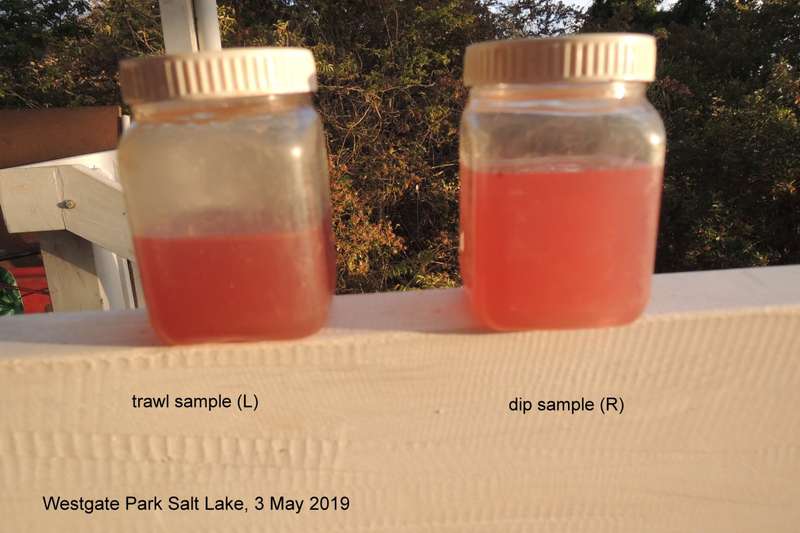
Westgate Biodiversity published the report with a June 2019 account attributing that season’s colour to the purple sulphur bacteria. [2] A Parks Victoria explainer published in 2022, by contrast, describes pink-lake colour through salt-adapted algae and pigments, applying that explanation to Westgate too. [3]
Those accounts should not be silently merged into one confident scientific name. Nor does the dated sample justify announcing that a later explanation has been disproved. What it offers a reader is something valuable and limited: a record of what one investigator actually found, with the qualifications still attached.
The lake was made into a view
The setting has its own history of selective attention. Victoria’s official history of Westgate Park describes a former sand mine converted into a saltwater lake. The winning landscape design by Loder & Bayly and Bruce Mackenzie used hills and tracks to frame views of the bridge, with fresh and saltwater lakes as focal points. The park opened in November 1985 in a reduced version of that ambitious scheme. [4]
So the water beneath the bridge is neither an untouched remnant nor simply an ornamental pool. A worked landscape became a public park, and the life within it continued to require observation.
Beyond the pink photograph
Westgate Biodiversity’s February 2025 wetlands account describes a more everyday water problem. The park has no convenient creek to replenish its lakes. Stormwater provides some inflow, and a windmill can transfer water between water bodies, slowly. Most of its wetlands other than the deeper salt lake are shallow and can dry during summer. [5]
The same account points to the slow-growing saltmarsh plants around the salt lake, planted and tended by volunteers and vulnerable to trampling. [5] The edge of the photograph is part of the place’s living fabric, not merely somewhere to stand for a better picture.
Powling’s jars do not diminish the striking view. They make it harder to stop at the view. A colour, a sample, a designed landscape and the people tending its margins each tell something different about this small piece of Port Melbourne.