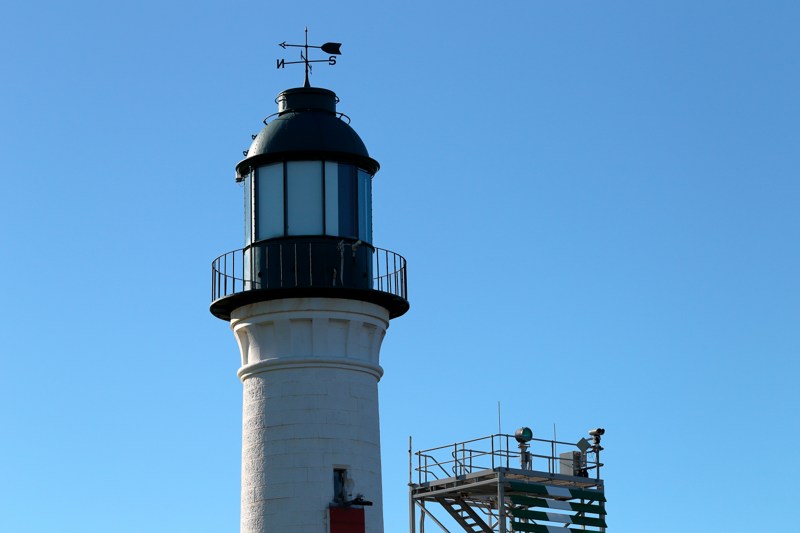
In Ed Dunens’s photograph of Queenscliff’s White Lighthouse, taken in July 2016, another structure edges into the frame. Beside the white masonry and dark lantern stands a metal platform carrying lights and equipment. The tower does not have the sky entirely to itself.
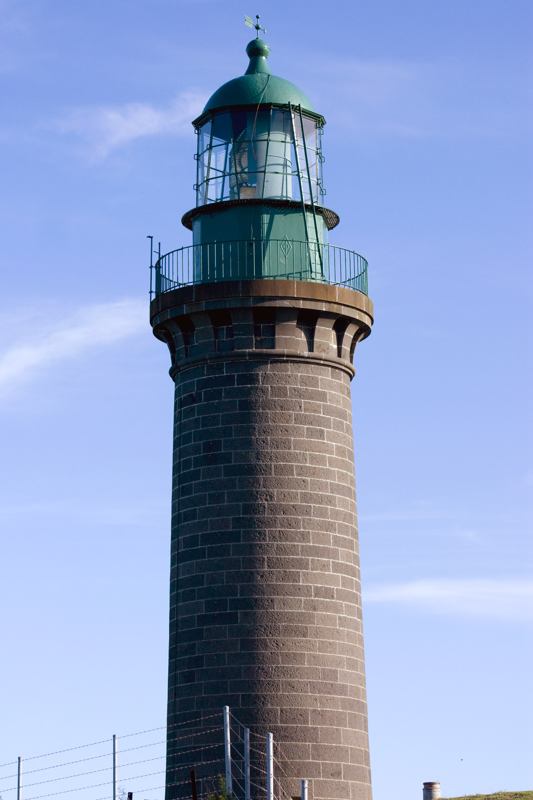
A photograph by Rexness shows its dark-stone counterpart, the Black Lighthouse, with green metalwork above and a fence below. These are separate views, taken years apart—not a demonstration of the lights’ alignment. They invite a different question: what disappears when each lighthouse is treated as an isolated landmark?
Where is this place?
Shortland’s Bluff and Queenscliff, Victoria — geographic context, not a navigation chart or access instruction. This map locates the town or region, not a verified exact historic event site.
At Shortland’s Bluff, looking beyond the individual tower turns out to be part of the preservation story.
Two towers, one relationship
A history prepared by Lovell Chen for the Borough of Queenscliffe describes the problem facing the first lighthouse, which began operating in 1843. A single light was not enough to establish the desired approach to the channel. Another light was needed for alignment; a timber tower followed in the 1850s. [1]
The later masonry pair also emerged from competing uses of the bluff. The original lighthouse’s site was wanted for a gun battery, while its soft sandstone had weathered poorly. The replacements were made from dressed bluestone carried by barge from Melbourne. Whitewash distinguished the lower tower from its dark partner. [1]
The contrast is therefore more than an attractive colour scheme. These buildings were conceived in relation to one another. The Heritage Council’s assessment describes the White and Black lighthouses as a pair designed and constructed together. [2]
This is an account of that historical relationship, not directions for navigating the entrance to Port Phillip Bay.
A boundary that could not contain the whole story
In February 2019, the Heritage Council of Victoria added Shortland’s Bluff to the Victorian Heritage Register. The endorsed report made an important distinction: the Black Lighthouse stood within Commonwealth-owned Fort Queenscliff, outside the place being assessed under the state legislation. The report nevertheless treated their shared history as essential context. [2]
Its reason for drawing the registration boundary went beyond collecting structures. The included land was intended to protect views towards the lighthouses and fort, and outward towards Point Lonsdale and Point Nepean. [2]
That is a less easily photographed kind of preservation. Masonry has edges; a view depends on the relationship between several places. A close-up can show the shape of a lantern beautifully while leaving that relationship outside the frame.
Looking through, not only looking at
The town’s maritime museum offers another way to think beyond the tower’s outline. Its lighthouse display, developed with assistance from the Australian Maritime Safety Authority, includes lenses, timing mechanisms and other lighthouse equipment. The museum describes an exhibit in which visitors can stand inside a lighthouse lens and observe the way its prisms change light and shapes. It does not identify that lens as coming from either Queenscliff tower. [3]
The distinction matters. An object can explain a technology without being a surviving part of the particular landmark outside. Likewise, the two photographs here reveal surfaces, colours and surrounding equipment without pretending to reproduce a mariner’s view from the water.
Queenscliff’s pair rewards that wider way of looking. Keep the towers, certainly. But the 2019 assessment also asks the reader to notice what lies around them—and what remains visible from one place to another.