The traffic had gone elsewhere, but Sale’s old bridge still could not perform its defining trick. In September 2003, a local account reported that a shifted foundation was obstructing the swing mechanism. The new road bypass had opened the previous year. Now the bridge itself was due for attention. [1]
At Longford, near Sale in Victoria, preservation meant more than keeping an iron crossing in the landscape. It meant making that crossing move again.
Where is this place?
Sale Swing Bridge, Longford, Victoria — location context, not a mapped works boundary. This map locates the town or region, not a verified exact historic event site.
A bridge with two jobs
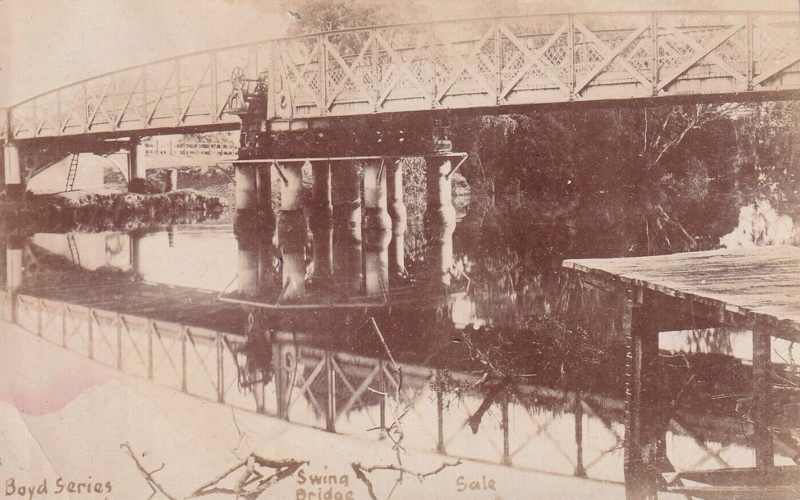
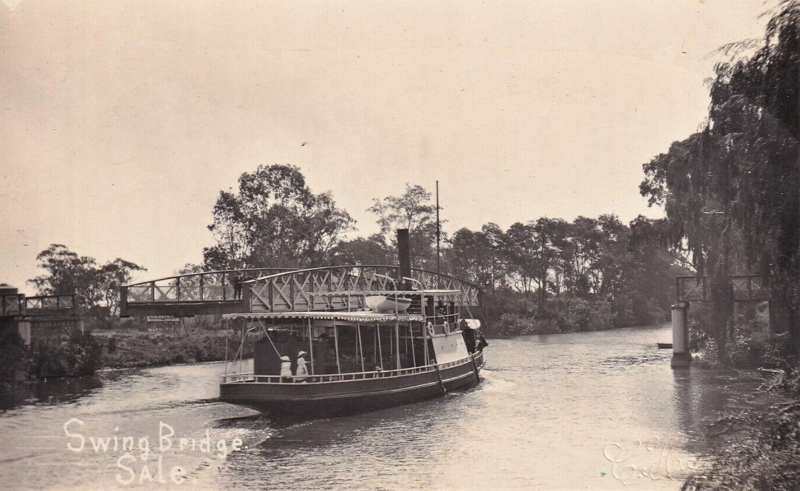
The Swing Bridge crosses the Latrobe River near its junction with the Thomson. The Victorian heritage record describes a wrought-iron structure whose central span rotated horizontally, opening a passage for vessels travelling towards Sale. A hand-operated winding mechanism turned the span around its central support. The same structure served people crossing the river and boats travelling along it. [2]
The historical photographs here show those two arrangements: the bridge across the water, and a steamer passing when the span had turned. They are not pictures of the restoration. The collector dates one postcard to 1908 and the other to the early twentieth century; neither is evidence of the bridge’s present condition. [6][7]
By 2003, the problem was not simply old paint. SaleCommunity.com’s September update, preserved by the La Trobe Society, described a first-stage contract to rebuild the foundation. Work on the swing mechanism, deck and railings was expected to follow. Its account separates the road bypass, completed in April 2002, from the repairs still ahead. [1]
The railings were somewhere else
An Engineers Australia heritage nomination provides an unusually tangible account of the refit. The bridge’s lattice iron balustrades had been removed. They were found at a VicRoads depot in Morwell, rather than having to be reconstructed entirely from photographs. The account describes repairs and replacement sections, alongside work on the operating mechanism. [3]
Recovering a railing and recovering a movement were different tasks. One restored a visible part of the bridge. The other restored the relationship between the crossing and the waterway beneath it.
The nomination also describes a portable hydraulic pump and motor mounted on a trailer to operate the bridge. Renewed movement did not mean pretending that every part of the working system remained exactly as it had been in the nineteenth century. A historical structure could retain its characteristic action while using later equipment to perform it. [3]
The local archive records an official reopening on 19 February 2006. That date marks a public occasion, not proof that every repair happened in the same year. [1]
Reopening was not the last maintenance entry
In February 2022, Wellington Shire Council announced another interruption. The downstream drive mechanism was to be removed for refurbishment, and public demonstrations of the swing would pause. The notice distinguished those demonstrations from pedestrian crossings and essential boat passage. It anticipated work lasting until approximately October; it does not establish when the work actually finished. [4]
That distinction matters. A bridge can be available for one purpose while temporarily unavailable for another. “Open” is not a complete description of a structure designed both to carry a crossing and to interrupt it.
Wellington’s 2024/25 annual report returned to the subject under “Swing Bridge Restoration Design.” It placed the Longford project in a proposed ten-year capital program, with an allocation of A$200,000 annually. Those are planning and budget statements, not evidence that ten years of restoration had already been delivered. [5]
The story therefore has no tidy final coat of paint. Diverting road traffic created room for a different future, but movement remained something to maintain, not merely something to unveil. Sale kept a bridge whose most distinctive act is to stop being a crossing for a while.
This is a history of restoration decisions, not a current opening timetable or access advisory.