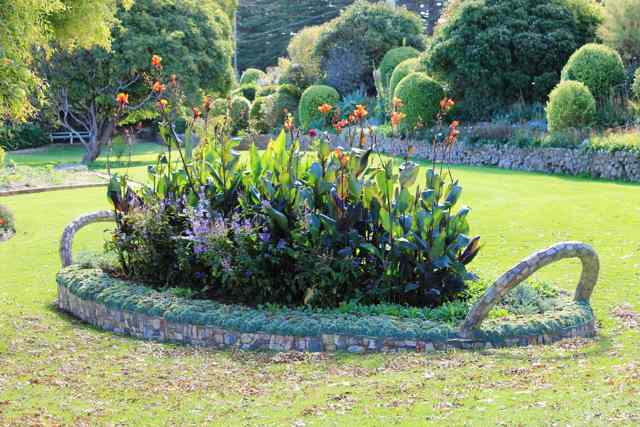
A basket sits on the lawn at Warrnambool’s former Fletcher Jones factory, but nobody could carry it away by its handles. In a photograph taken in April 2015, its stone-faced sides enclose a flower bed. Orange blooms rise from the middle; two curved handles turn a piece of garden architecture into something playfully domestic.
Another photograph from that day shows a taller loop above a different bed, with the factory buildings behind it. These are not loose ornaments placed in front of an industrial story. They belong to the story’s physical setting.
Where is this place?
Fletcher Jones Factory and Gardens area, Flaxman Street, Warrnambool — geographic context, not a visitor-access guarantee. This map locates the town or region, not a verified exact historic event site.
There is a surprisingly precise place to find that distinction: the Victoria Government Gazette of 3 August 2006. Its registration notice for the Fletcher Jones Factory and Gardens includes the factory, a Quonset hut and the water tower. Farther down the same list appear five flower baskets. [1]
The list gets smaller, and more revealing
The notice moves from large structures to the garden’s smaller provisions: a wishing well, pergolas, lamps, seats and urns. It records twenty lamps and twenty-four concrete-and-timber seats. A workplace was being recognised through places to pause as well as places to produce. [1]
That is a reading of the list, not a claim that a legal document can explain every lunch break. Nor does it establish that every plant visible in the 2015 photographs survives today. The flowers and the structures holding them are different kinds of evidence.
The University of Melbourne Archives places Pleasant Hill’s factory and gardens within the company’s post-war expansion. Its collection introduction describes Fletcher Jones & Staff as a business in which employees shared in profits, with a co-operative model influenced by the Japanese reformer Toyohiko Kagawa. The garden belonged to a larger experiment in organising working life, not simply to the manufacturer’s advertising image. [2]
Remembering what people did there
The site’s digital garden tour makes that relationship personal. Its “Ethical Workplace” section presents a recollection attributed to Betty Goodman of eating lunch in the gardens. It also reproduces memories of the staff canteen and describes the garden as a setting for relaxation and gatherings. These are selected recollections presented by the tour, not interviews conducted for this article or proof that every employee experienced the company in the same way. [3]
A second section follows a gift beyond the factory gate. It tells how Claire Jennings received a book at a staff Christmas party as a child in the early 1960s, kept it, and brought it to a community Christmas gathering in the gardens in 2015. The object connected an adult’s return with an occasion remembered from childhood. [4]
The tour was produced by heritage-studies students working with local stakeholders. It combines the landscape with stories that a visitor cannot recover by looking at a flower bed alone. Its contributors’ memories add something that the registration notice cannot supply: how a formally listed place fitted into ordinary lives. [5]
Not just the big landmark
The factory’s elevated water tank, the Silver Ball, is the feature most easily made into a skyline symbol. Yet the 2006 notice gives the garden’s baskets their own entry, alongside the industrial buildings. [1]
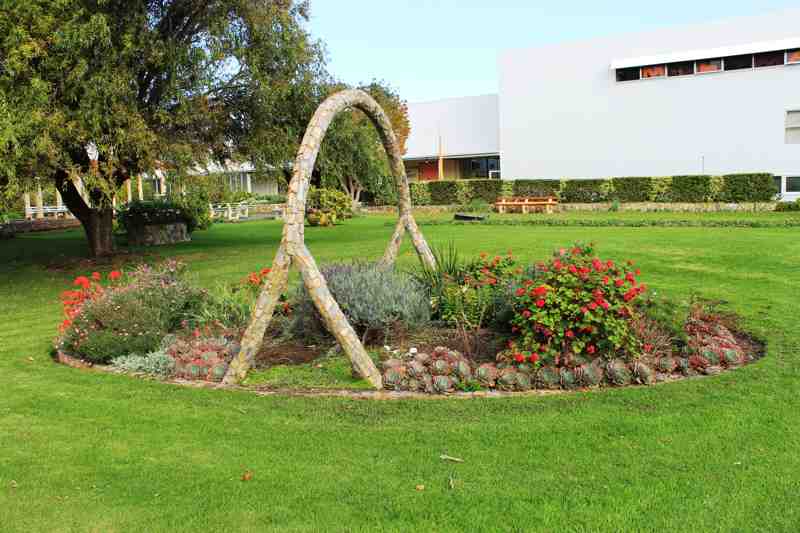
The two photographs here offer a quieter scale: clipped shrubs, lawn, a bench in the distance, flowers contained within stone curves. They show a particular day in 2015, not an unchanged scene stretching back to the factory’s opening.
Read beside the memories, those oversized baskets become more than an amusing design. They help make room in an industrial history for the hours when people were not at their machines.