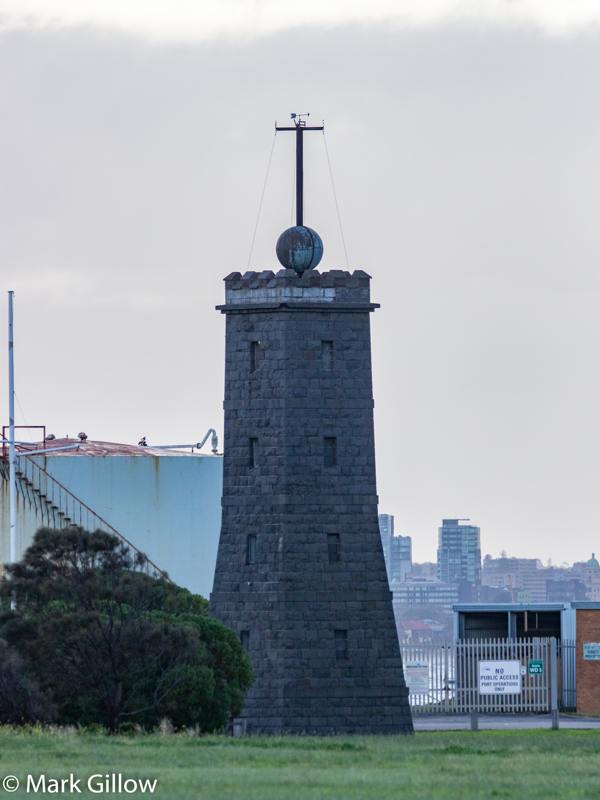
Williamstown’s Timeball Tower has lost part of its skyline on purpose. Mark Gillow’s photographs from March 2020 show a square stone tower, battlements and a ball on a mast. They do not show the round brick extension that once rose above the stonework. That addition was removed in the late 1980s, when the time-ball apparatus was reconstructed. [1][2]
The shorter building is not simply an untouched survivor. Its familiar outline embodies a decision about which of its working lives to make visible.
Where is this place?
Timeball Tower, Point Gellibrand, Williamstown — geographic context, not current visitor access or navigation advice. This map locates the town or region, not a verified exact historic event site.
A signal, not a clock face
At Point Gellibrand, the tower’s time signal served ships in Hobsons Bay. The council’s account explains its purpose: a ball descending at one in the afternoon allowed mariners to check their chronometers, the timekeepers used for navigation. The tower had begun as a lighthouse before taking on this different task. [3]
A guide published by the Williamstown Historical Society in 1972, revised in 1982 and reproduced on its website, describes the apparatus in more physical terms. A copper sphere surrounded the mast; a sheet-iron cup received it at the bottom. The ball was raised shortly before the hour, then released. The guide also describes electrical control replacing manual operation and linking time signals in Williamstown, Melbourne and Geelong. [4]
This was not a display from which a passer-by could read any minute of the day. Its useful information was an event: the moment the signal was given. A ball and a mast could communicate that without a numbered dial.
When the signal stopped
The historical society’s guide offers a striking account of the service’s end. It says the ball stopped for ten days during the final keeper’s illness in 1926, without official complaints being received. With marine wireless becoming more widely used, the signal was subsequently abandoned. [4]
That is the society’s retrospective account, not proof that every mariner had stopped caring about the tower. Tony Dingle’s eMelbourne entry independently records the end of the time-ball service in 1926, without repeating the no-complaints episode. [2]
Nor did the stone building’s working life end with the signal. In the 1930s a cylindrical brick extension was added for a more powerful light. The municipal heritage study explains the practical point: the light needed to stand out from Melbourne’s city lights. The tower became taller to do another useful job. [1][2]
Restoration by subtraction
The heritage study records a later reversal. Between 1987 and 1989, the added brick tower was removed, the stone tower’s battlements restored and the time ball recreated. It describes the resulting form as an expression of the earlier time-ball function. [1]
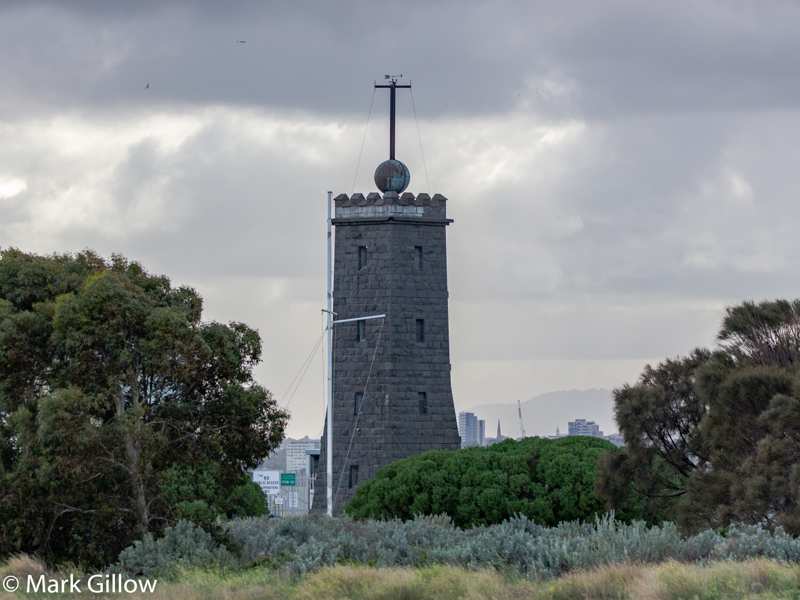
The distinction matters. The ball in Gillow’s photographs belongs to that reconstructed presentation; it should not be mistaken for an apparatus that had remained unchanged and continuously in service since the nineteenth century. These two views, taken on the same morning in 2020, are neither a before-and-after pair nor evidence of a present operating schedule.
Williamstown’s tower makes preservation’s choices unusually legible. Keeping every addition would have preserved a different silhouette. Removing the brick extension brought an older function back into view, but the missing addition was history too: evidence of a port’s changing needs, not merely an error waiting to be corrected.