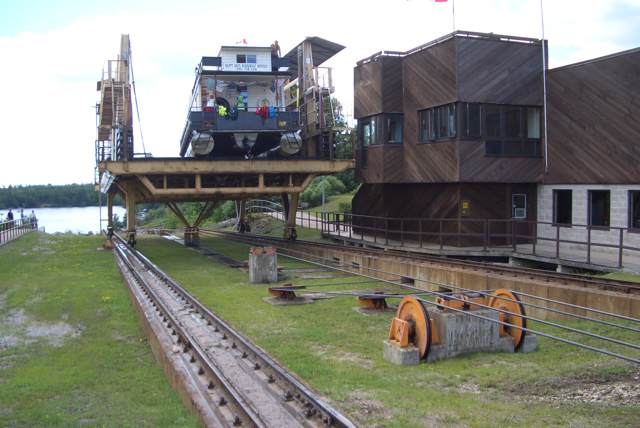
The houseboat in Motorbiker’s 2007 photograph sits above rails, cables and grass beside a timber-clad control building. At Big Chute, near Coldwater, Ontario, a railway carriage carries boats through a short journey that their engines cannot make for them.
Parks Canada lists this place as Lock 44 on the Trent–Severn Waterway. But the crossing is not a conventional chamber that raises or lowers a boat in water. The boat travels over land. That interruption became a reason to keep the railway, rather than simply an inconvenience to remove. [1, 2]
Where is this place?
Big Chute Marine Railway, Ontario — named-site context, not a boarding or navigation instruction. This map locates the town or region, not a verified exact historic event site.
A temporary answer acquired another purpose
The first railway was not built as a response to sea lamprey. Parks Canada’s history begins with contracts awarded in 1914 for locks connecting the Severn River to Georgian Bay. Wartime shortages intervened. A marine railway opened in 1917, followed by a replacement in 1923. [1]
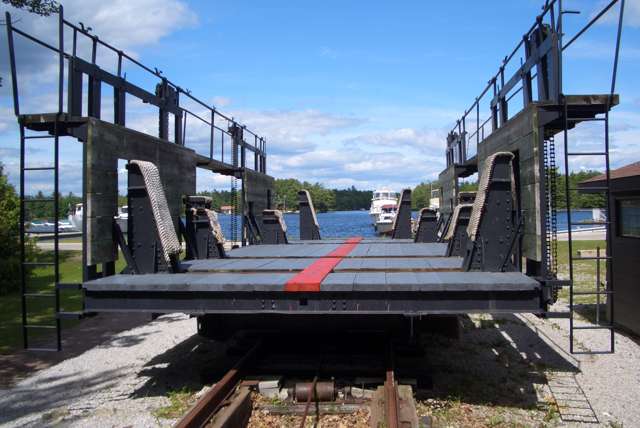
The older carriage in a second photograph makes the arrangement easy to recognise: a broad platform, rails underneath, tall sides and padded supports. An archived educational account explains the general process. A carriage runs partly underwater, receives a floating boat, carries it over the incline and submerges again so the boat can float away. Electric motors and winch cables do the hauling. [2]
Temporary did not mean untouched. An interpretive panel transcribed in the Historical Marker Database describes the 1923–24 rebuilding: a larger car, new motors and winches, landing facilities and a reconstructed track. It also records an unfinished alternative. Work on conventional locks began in 1919 but stopped in 1921 during the post-war recession. The railway’s survival was not the execution of one uninterrupted master plan. [3]
What a lock might let through
By the 1960s and 1970s, the panel explains, increasing boat traffic had outgrown the older railway. A lock offered a possible answer—but also a possible route for lamprey into the Lake Simcoe fishery. A larger railway was chosen instead. The present crossing opened in 1978. [1, 3]
The concern had a wider precedent. The Great Lakes Fishery Commission explains that improvements to the Welland Canal allowed sea lamprey to get around the natural barrier of Niagara Falls and reach the upper Great Lakes. These parasitic fish attach to other fish and feed on their body fluids; an opening made for navigation can carry ecological consequences as well. [4]
At Big Chute, Parks Canada credits the railway with helping halt sea lamprey’s spread to inland lakes. That is a specific role, not a guarantee that an overland crossing excludes every invasive organism. Nor is it a claim that the river itself stops flowing. The distinction is between moving vessels across an obstacle and opening a continuous navigable passage through it. [1, 2]
The two photographed carriages belong to different generations of machinery. What connects them is not just a method of lifting boats. A workaround for one period’s shortages became infrastructure worth renewing because it preserved a useful break.