
Gold leaf sounds like the decorative part of a restoration: the finishing flourish after the serious repairs are done. On Halifax’s Town Clock, it also had a practical assignment. People were supposed to be able to read the hands and numerals.
When Parks Canada described an exterior renovation in July 2018, visibility was part of the brief. Spokesperson Jonathan Nash told a local radio programme that the hands and numerals would receive gold leaf. The plans also included less reflective glass and new lighting, alongside roof and window work. Meghan Groff’s contemporary report recorded these as proposed improvements, not completed results. [1]
Where is this place?
Old Town Clock, Citadel Hill, Halifax — geographic context, not current access or clock-service guidance. This map locates the town or region, not a verified exact historic event site.
Architecture49’s later account of its work supplies the next part of the story. The project’s prime consultant identifies improved dial legibility among the restoration tasks and records gold-leaf hands and numerals against cobalt-blue faces. [2]
A familiar landmark was also a public display. Keeping the machinery going and making its message visible were different jobs.
The colour was a conservation decision
The blue was not presented as a newly fashionable accent. Architecture49 says it drew on eighteenth- and nineteenth-century examples. That is a claim about historical comparison—not proof that paint analysis had recovered the exact shade applied in Halifax in 1803. The distinction matters when a restoration looks convincingly old. [2]
The firm also describes an effort to keep modern interventions visually unobtrusive and reversible, using period-compatible materials except where necessary. Repairing leaks, copper roofing and architectural details sat alongside the work on the faces. The project account is dated March 2020; it does not turn every item promised in 2018 into a separately verified completion. [2]
Nor do the two photographs here provide a controlled test of the change. The view published by Steve Knight in 2010 and the photograph taken by the Flickr contributor prayitnophotography in 2024 differ in angle, light and framing. They show the clock in its hillside setting. They cannot tell us how easily a particular passer-by could read it before and after the work.
An older mechanism inside a renewed building
Parks Canada dates the clock’s installation to October 1803. Its history, updated in April 2024, makes a useful distinction: the building was largely reconstructed in the early 1960s, while the original clockworks remained intact and in use. It credits the timepiece to London’s House of Vulliamy. The age of the mechanism is not a date stamp for every visible board, roof surface or coat of paint. [3]
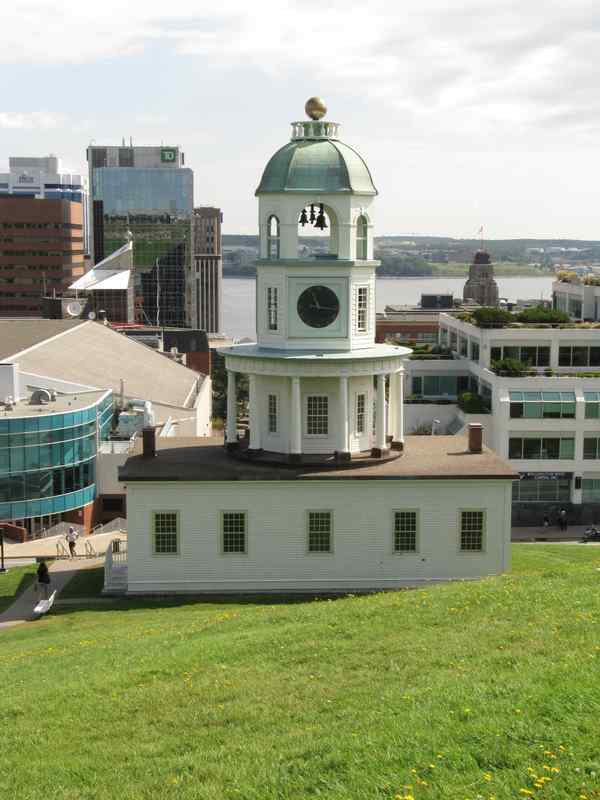
The building around it required recurring attention. A federal contract announcement from September 2005 proposed repairs to twelve wooden stave columns, flat roofs, copper flashings and windows, as well as exterior painting. That announcement documents another maintenance programme, not proof of precisely when each repair was finished. [4]
During the renovation announced in 2018, protecting the old machinery meant temporarily stopping the clock and enclosing its mechanism while roof work took place. Nash explained that the enclosure would keep dirt and debris out. Even the interruption was intended to protect the timepiece. [1]
These records describe continuity made through changes: a long-lived mechanism, a substantially renewed building and a face whose readability received deliberate attention. Gold belongs in that account not simply because it looks precious. On a clock above the street, it was being asked to help make the time visible.