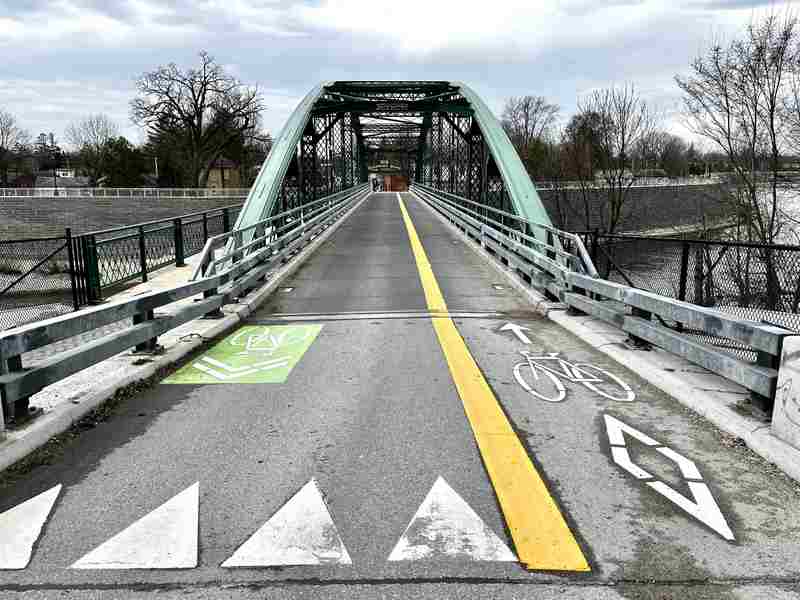
The curved ironwork is what makes Blackfriars Bridge recognizable. A detail of its replacement roadway tells a different story: the deck’s curbs received stainless-steel protection for snowploughing. Preserving a nineteenth-century crossing in London, Ontario, involved preparing new material for an ordinary winter job. [1]
Creative Composites Group identifies the vehicle deck as fibre-reinforced polymer, or FRP. Its project record lists the deck’s own weight as 25 pounds per square foot—not a limit on the weight of traffic. This was a modern component in a rehabilitation, not a surviving road surface from 1875. [1]
Where is this place?
Blackfriars Bridge, London, Ontario — crossing context, not a current traffic or access guide. This map locates the town or region, not a verified exact historic event site.
Leaving the river to return to it
Dillon Consulting, the project’s engineering consultant, dates the bridge’s opening to September 1875. It spans the north branch of the Thames between Blackfriars Street and Ridout Street North. The familiar river name and bridge name belong here to Ontario, not to the crossing in London, England. [2]
The rehabilitation was not simply a painting job performed above the water. Dillon describes lifting the structure from its supports, taking it apart and sending it to a fabrication facility before returning it for reassembly. The bridge reopened on December 1, 2018. [2]
That journey made the distinction between a bridge and its individual parts unusually clear. Keeping the crossing did not mean keeping every piece that had made it work.
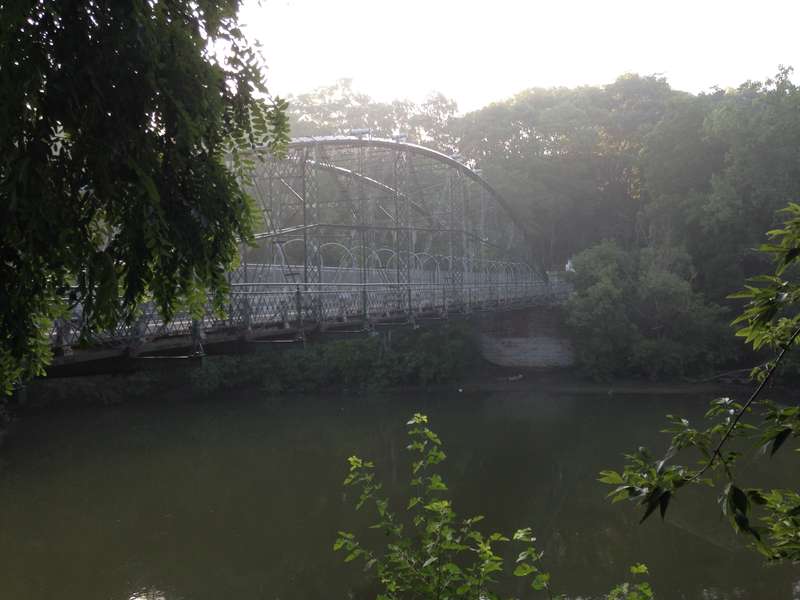
New pieces, retained pieces
Iron Bridge Fabrication’s own project list separates new manufacture from rehabilitation. Its new work included floor beams, stringers and bracing; other existing features were repaired. [3] Dillon likewise records replacement work alongside the rehabilitation and reuse of pedestrian railings. [2] The result cannot accurately be described either as an untouched antique or as a wholly new structure with an old name.
Nor was its heritage value assessed identically by everyone. HistoricBridges.org, whose record documents the bridge before and after the project, argues that the replacements and changed appearance caused a serious loss of historic integrity. Its criticism also acknowledges the bridge’s previous deterioration and the desire to retain vehicle use. [4]
That is a preservation judgment, not a finding that the bridge was unsafe. Set beside the project participants’ accounts, it identifies the real disagreement: how much continuity lies in retaining a recognizable, useful crossing, and how much depends on retaining its particular material and design?
A repaired bridge still needed a decision
Even the question of use did not end with reopening. In a November 2021 notice, the city explained that motor vehicles had been excluded in April 2020 to make room for pandemic distancing. Council was about to consider keeping that arrangement and beginning a review of the bridge’s operation. The notice also said the earlier environmental assessment required use to be revisited within five years of project completion. [5]
That notice records a decision still ahead in 2021, not today’s traffic rules. It does show why structural rehabilitation and deciding who should cross are separate tasks.
The composite roadway is one answer to the problem of keeping an old bridge in service. The retained railings, replacement members and later discussion of access answer different parts of it. A reopening date marks a useful achievement; it does not make every question about preservation disappear.