By the time wildfire destroyed twelve wooden trestles in Myra Canyon in 2003, the bridges had already outlived their railway job. Walkers and cyclists were using the former Kettle Valley Railway near Kelowna. Rebuilding the crossing meant deciding how much of a railway’s appearance a trail should keep. [1]
The answer was not simply to reproduce every piece. The restoration plan announced in August 2004 called for some rebuilt trestles to mimic the originals and others to follow their general character. The distinction matters: a recognizable historic route could contain both surviving structures and new construction. [1]
Where is this place?
Myra Canyon, near Kelowna, British Columbia — geographic context, not trail access or driving directions. This map locates the town or region, not a verified exact historic event site.
More survived than a silhouette
Parks Canada’s heritage record identifies the railway’s achievement in its location, layout and construction through steep mountain terrain. Built through Myra Canyon between 1912 and 1914, the line combined trestles, tunnels and roadbed rather than relying on one spectacular bridge. The protected place is a connected engineering work in a landscape. [2]
Nor did the fire erase every crossing. The 2004 government account distinguishes sixteen wooden trestles from two steel bridges. Twelve wooden structures were destroyed; the steel crossings were damaged. Parks Canada specifically names wooden trestles 1, 12, 16 and 17 among the survivors. Calling the entire route a replica would lose that distinction. [1, 2]
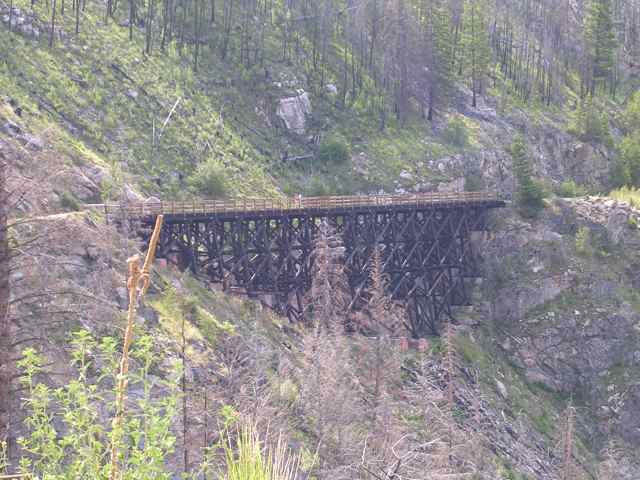
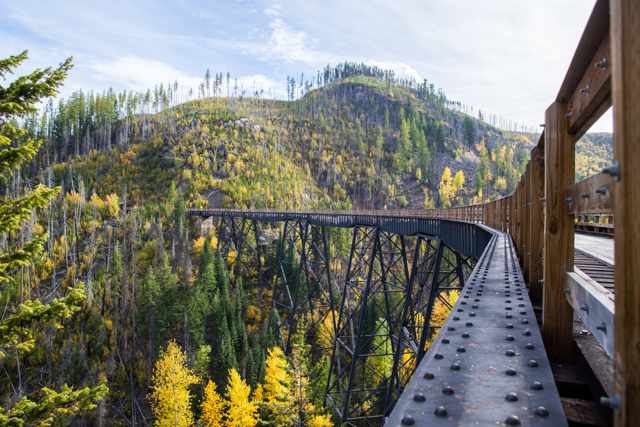
The photographs here show another difference that a simple count can hide. Su-Laine’s June 2008 view shows a timber trestle against the canyon slope; its individual number is not established by the photograph’s record. Mack Male’s September 2016 image shows the long steel structure of trestle 6, with a wooden railing beside the walkway. They are different crossings, not a before-and-after pair.
A return that allowed changes
Even survival did not mean remaining untouched. A September 2005 provincial progress report said trestles 1, 16 and 17 had been repaired and widened. It also distinguished the completed reconstruction of trestle 18 from work still underway elsewhere. The route returned in stages, not as one finished object delivered all at once. [3]
That is visible in a particularly useful account written before the work was complete. In July 2007, Trans Canada Trail chair Valerie Pringle described a ride she had made with restoration society member Ken Campbell that May. They crossed three surviving trestles and seven rebuilt ones, passed through both tunnels and reached trestle 8. [4]
Pringle was reporting a partial journey through an active reconstruction project. Her article still looked forward to the next spring’s reopening; it was not evidence that the whole trail had already reopened. Read beside the provincial progress report, it makes the mixture of old and new much more concrete than the single word “restored”. [3, 4]
The local stewardship history records the final reconstruction work in early 2008. But finishing bridges did not finish the trail’s work. It distinguishes government-funded replacement and fire-related repairs from volunteer-funded improvements such as interpretation and trail-surface work. [5]
That division was already visible in the 2004 funding announcement, which described donated money supporting items such as benches and interpretive displays outside the eligible disaster-restoration costs. Reconnecting the route and helping people understand it were related tasks, but not identical budget lines. [1]
The stewardship history also records a later change: the Myra Canyon Trestle Restoration Society dissolved in November 2022 and began transferring its assets to Friends of the South Slopes. The bridges’ care had a history after reconstruction, just as the bridges had a history after trains. [5]
Myra Canyon’s continuity is not proof that everything stayed original. It lies in a route whose surviving and replacement parts still let people follow the difficult line through the canyon—and in the work needed to keep those parts connected.