The paddlers in the photograph are threading gates on a channel beside Ottawa’s old waterworks. Their course is not simply a stretch of river that happens to pass a historic building. Ottawa River Runners operates the Pumphouse at the Fleet Street Pumping Station’s tailrace—the channel carrying water away after it has done mechanical work. [1,2]
That connection reaches into the club’s calendar. Its 2026 camp information explains that scheduled maintenance shut-offs at the pumping station can require programmes to move to an alternative site. [3] Here, planning time on the rapids includes planning around the waterworks.
Where is this place?
Fleet Street Pumping Station and Pumphouse tailrace, LeBreton Flats, Ottawa — context only, not an access route or current paddling conditions. This map locates the town or region, not a verified exact historic event site.
Water working on water
The Canadian Society for Civil Engineering traces the station’s pumping service to 1874. Thomas Keefer, appointed chief engineer for construction in 1872, chose water power for Ottawa, unlike the steam power used in his earlier Hamilton waterworks. [4] The survival of that principle does not mean every pump is an original machine.
A useful explanation of the later arrangement comes from a 2019 statement by city water-production manager M. Paul Montgomery, reproduced, with editing disclosed, on Charles Akben-Marchand’s Images of Centretown blog. Montgomery described river water turning turbines, which drove gearboxes and then the pumps directly. It was not a sequence in which a turbine generated electricity for an electric pump motor. The station nevertheless needed some electricity for controls and lighting. [2]
The water being pumped was a separate supply. Montgomery described treated drinking water arriving from the Lemieux Island Water Treatment Plant to feed the pumps. [2] One flow supplied the mechanical energy; another was moved into the city’s distribution system. The paddling channel should not be mistaken for the route taken by the treated drinking water.
This is not only an ingenious arrangement recalled from an old engineer’s account. Ottawa’s 2024 Energy Conservation and Demand Management Plan still identifies hydraulic power at Fleet Street as a way to reduce the electricity needed for drinking-water distribution. [5] That is the city’s dated account of an operating energy measure, not a claim that the whole station runs without electricity.
A course downstream of the machinery
The water leaving the station acquires another use. Ottawa River Runners describes a whitewater course at the tailrace, followed by a moving-water beginners’ area where the outflow meets the Ottawa River near Victoria Island. The club maintains the course through financial and volunteer work and uses the site under an agreement with the city. [1] It is a managed sporting facility, not an invitation to enter any convenient piece of water.
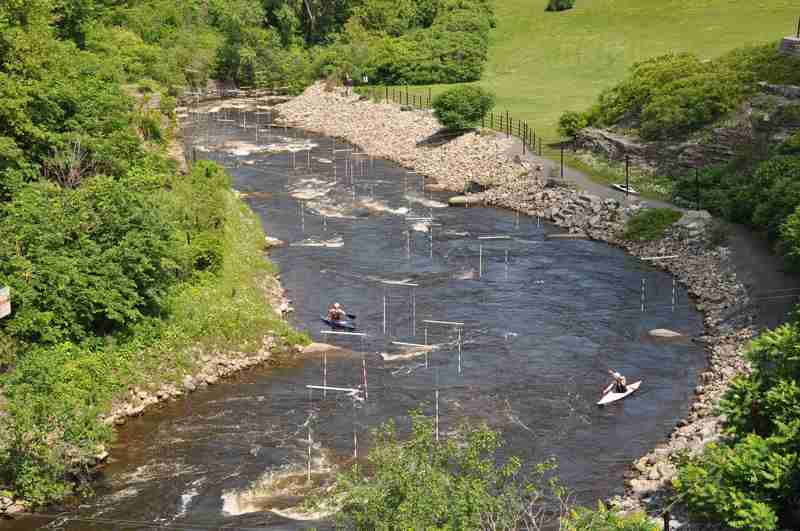
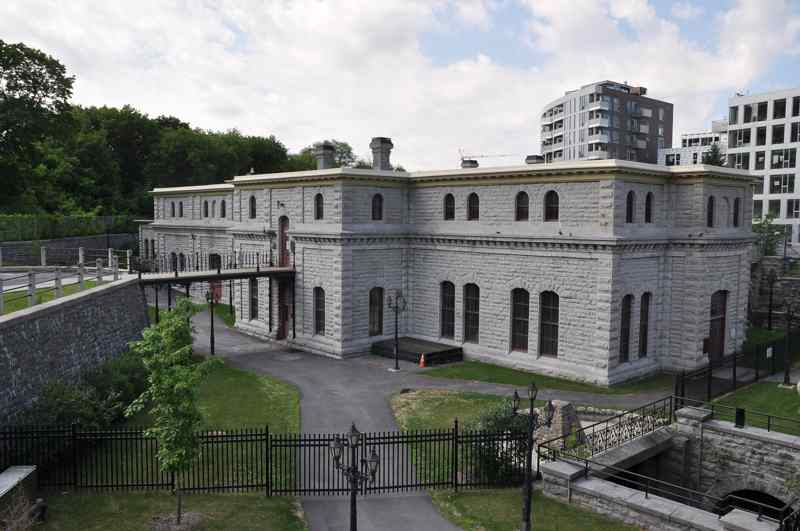
The two photographs, both dated June 2015 by their photographer, make different parts of the relationship visible. One shows the substantial stone pumping station. The other shows gates and paddlers in the channel. Neither is a photograph of the hidden machinery, nor evidence of today’s flow conditions.
The camp arrangements supply the less picturesque detail that joins those scenes. A maintenance stoppage upstream can change where people learn to paddle downstream. [3] Fleet Street’s heritage is not confined to a building that looks old. It includes a working relationship between the city’s water supply and a small, carefully managed place to practise moving through water.