The boat beneath Port Stanley’s lift bridge in September 1978 was not simply passing through. According to a photograph record preserved by Elgin County Archives, workers stood on a vessel designed for the repair project so they could reach the underside of the crossing. The archive describes six weeks of closure while $500,000 in alterations were completed. [1]
A bridge is usually pictured from the road or the shore. This record changes the viewpoint: before anyone could repair it, they needed somewhere to stand. The temporary boat was part of the work of keeping a permanent crossing useful.
Where is this place?
Port Stanley, Ontario — town orientation, not a reconstruction of the 1978 work platform. This map locates the town or region, not a verified exact historic event site.
That small detail opens a larger question. When a town preserves a moving bridge, how much of the necessary work happens beyond the familiar outline?
A landmark is also a machine
The King George VI Lift Bridge carries Bridge Street across Kettle Creek. HistoricBridges.org’s documentation identifies a double-leaf bascule bridge built by the Dominion Bridge Company and dates it to 1939. Its two lifting leaves make the crossing a machine as well as a route. The page dates its bridge documentation to December 2018, before the later major rehabilitation. Its description should not be mistaken for a present-condition inspection. [2]
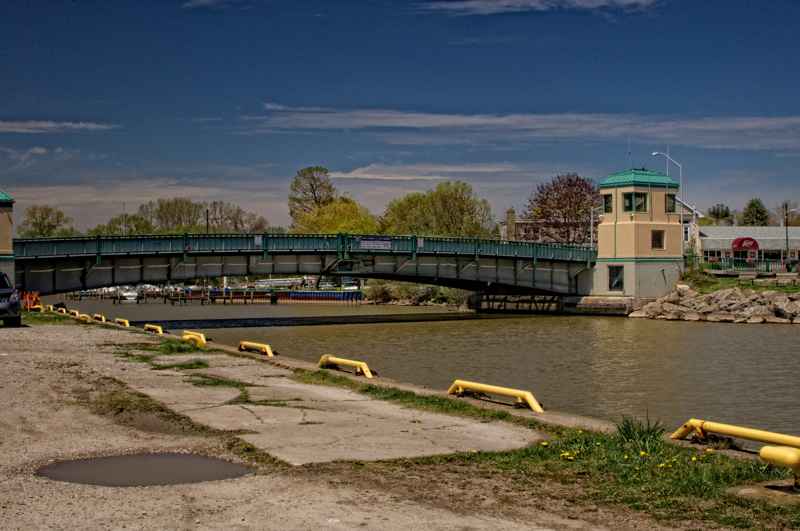
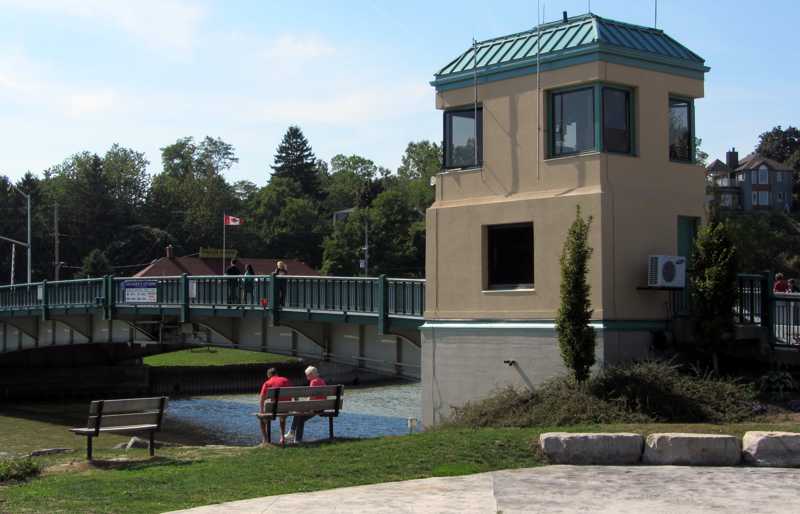
The photographs accompanying this article date from 2012, earlier still. They show the bridge and its control building. They are not photographs of the 1978 workshop or the 2021 work, and do not establish the bridge’s current appearance.
Landform Civil Infrastructure’s account of its King George VI project supplies a different kind of portrait. It lists replacement steel in the lifting spans, repairs to concrete and sidewalks, and protective coating. The mechanical work included replacing the high-speed drive, rehabilitating the low-speed drive, replacing the span-lock actuator, and balancing and commissioning the spans. Electrical work included a new control console, programmable controls and traffic gates. [3]
These are not interchangeable ways of saying that the bridge was painted. They describe different parts of a working system: the structure, the equipment that moves it, and the controls that coordinate its operation. The contractor’s account makes the largely unseen work legible without requiring the reader to mistake an attractive exterior for a complete maintenance history.
The project reached other streets
The work also had consequences away from the bridge itself. Elgin County’s council highlights from 2021 record a request from the Municipality of Central Elgin: retain the temporary traffic-signal improvements at Warren Street’s intersections with Carlow Road and Sunset Road. Those improvements had been installed for the lift-bridge capital project. [4]
The distinction in the record matters. It describes a request and a direction to investigate, not proof that permanent signals were approved or installed. Even so, it shows the rehabilitation reaching into the surrounding road network. Keeping one crossing required arrangements elsewhere; the temporary arrangements became a subject of municipal discussion in their own right.
Reopening was one date, not the whole story
The county’s 2021 annual report records that the bridge reopened on July 9. It describes mechanical, electrical and structural upgrades alongside a changed paint colour and historical lighting. Students from Kettle Creek Public School’s graduating Grade Eight class joined the official reopening occasion. [5]
A separate published construction certificate gives July 9, 2021 as the date of substantial performance. It names Elgin County as owner, Landform as contractor and GM BluePlan as payment certifier. The certificate was signed in August. That record corroborates a project milestone; it is not a claim about every later inspection or today’s operating arrangements. [6]
The opening ceremony and the contractor’s work list tell different parts of the same story. One marks the crossing’s return to public use. The other explains some of what had to change for that return to happen.
The 1978 boat belongs to a different repair campaign, decades earlier. Nothing in these records establishes that the later contractors used the same method. Its value is more modest, and more memorable: it reminds us to look below the landmark. Sometimes the story of keeping a bridge begins with the temporary platform used to reach it.