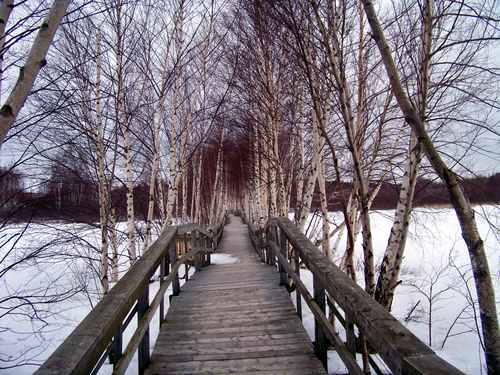
In Larry’s March 2013 photograph of Sackville Waterfowl Park, a boardwalk runs between pale tree trunks, with snow on either side. The route is unmistakably made for people. What people were meant to do beside the water was a more carefully drawn question.
The park’s 1988 advisory committee did not want duck feeding to become an attraction. Its development plan recommended a prohibition on handouts and rejected the idea of a semi-domesticated collection of wildlife. This was a proposal for how the park should work, not evidence of a bylaw in force today. [1]
Where is this place?
Sackville Waterfowl Park, New Brunswick — geographic context, not a current trail or wildlife-location guide. This map locates the town or region, not a verified exact historic event site.
A wetland with human beginnings
Ducks Unlimited Canada identifies the park as a joint undertaking with the Town of Sackville, established in 1988. Its description places this network of trails, boardwalks and viewing platforms in the heart of the New Brunswick community. The proximity to everyday human life was part of the project, not something hidden by its name. [2]
The water itself had a history of intervention. Canadian Wildlife Service researcher A. R. Hanson described the shallow freshwater wetland as land reflooded in 1988 after earlier drainage for agriculture. It was not an untouched landscape into which someone had simply inserted a path. [3]
Nor did the planning committee equate conservation with doing nothing. The document, dated 9 March 1988, advocated limited disturbance on the upland fringe while allowing occasional wetland management. It also called for repeated surveys of water chemistry and aquatic invertebrates. The ambition was to understand what the habitat could sustain, rather than judge the park only by what a visitor could immediately see. [1]
Looking below the surface
Hanson’s research abstract, published in a 2006 Canadian Wildlife Service proceedings volume, supplies a different kind of evidence from a planning aspiration. It reports abundant aquatic invertebrates and six fish species caught in minnow traps. For 1991–96, the wetland produced an average of 50 waterbird broods annually. These are dated research observations, not a promise about this year’s birds. [3]
The distinction matters. A brood count concerns birds breeding at the wetland; it is not a count of ducks gathered around a person with food. Hanson’s abstract is not an experiment proving that the committee’s feeding proposal caused those results. It does, however, give the story something more substantial than a picturesque pond or an inventory of amenities.
Two sorts of shelter
Larry’s other photograph, from November 2006, concentrates on a muskrat lodge: a low mound of plant material surrounded by water and upright stems. No animal is visible. The picture offers neither a population survey nor evidence of the lodge’s survival today. It records a different structure from the boardwalk—one identified by the photographer as wildlife’s shelter rather than a route for human observers.
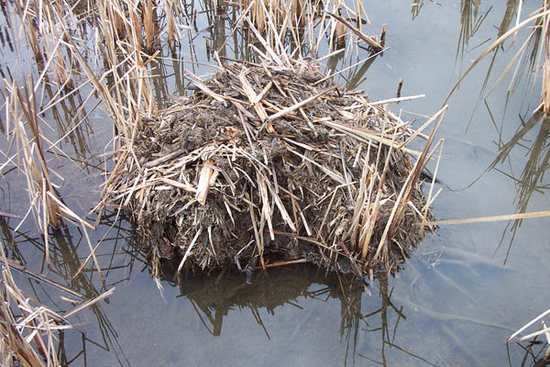
The two images are not a before-and-after pair. They direct attention to different users of the same named park. Read alongside the plan and the dated research, they suggest a useful way of understanding Sackville’s project: building a place to watch wildlife did not mean making the wildlife perform for visitors.