A cathedral questionnaire from October 1968 did not begin with stonework. It asked whether people preferred chiefly to listen or to pray with others, to watch a ceremony or participate. Only later came questions about reusing the façade and walls. The blank form, reproduced in Winnipeg’s 2012 heritage report, records the questions the parish circulated about life inside a replacement church—not simply its appearance. [1]
Fire had destroyed Saint-Boniface Cathedral’s nave and roof on 22 July 1968. The sacristies survived, according to the Société historique de Saint-Boniface’s account. Rebuilding the familiar outline was not the only possible response to the loss. [2]
Where is this place?
Saint-Boniface Cathedral, 190 Avenue de la Cathédrale, Winnipeg — geographic context. This map locates the town or region, not a verified exact historic event site.
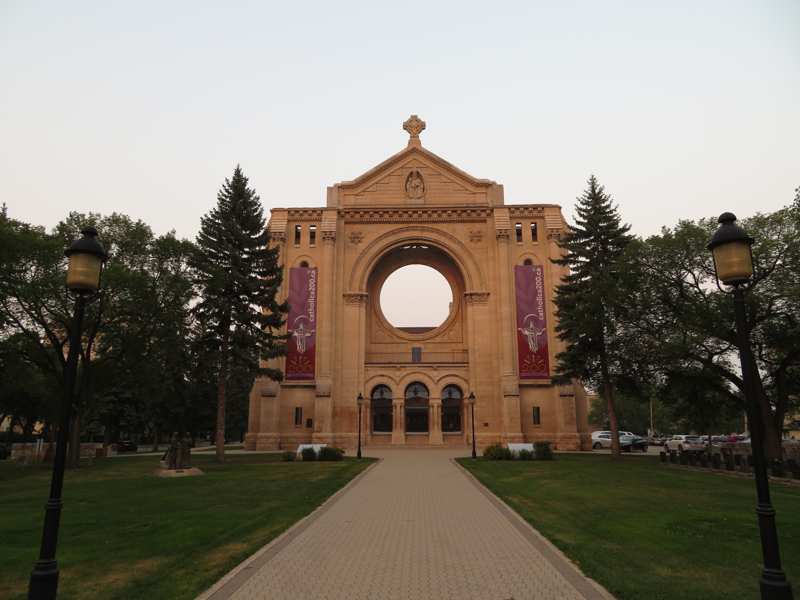
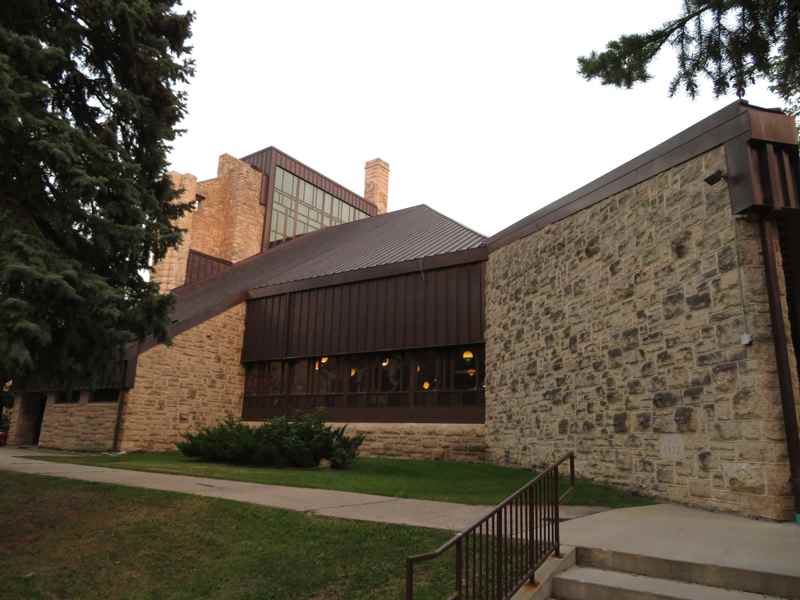
The eventual answer put a smaller modern church within the old building’s remains. Ken Lund’s two photographs from August 2018 show the difference: a monumental façade with an empty circular window, and a lower, angular building with broad glazing. The recognisable landmark and the enclosed church are not the same architectural object. [3]
A building for more than Sunday
The questionnaire also asked about a multipurpose building and whether its worship space should serve other purposes. It invited respondents to rank historical, financial, practical, religious and artistic considerations. These were questions, not a published tally of answers; the reproduced sheet cannot establish a unanimous preference. [1]
A later statement by parish priest Raymond Roy gives the smaller church a purpose beyond economy. The historical society reproduces his three-part proposal from La Liberté in July 1972: reduce the building’s size, make seeing and hearing one another easier, and provide a community setting useful beyond Sunday worship. Part of that setting would be principally for religious services. That programme placed the congregation’s experience alongside the survival of the masonry. [2]
The design made room for change without erasing the fire. Winnipeg Architecture Foundation describes Étienne Gaboury’s decision to retain the ruins while inserting a new church. Both generations used Manitoba Tyndall limestone, but the modern building’s angular forms distinguished it from the older work. Shared material did not require a copied silhouette. [3]
The parish dates the new cathedral’s blessing to 17 July 1972. Its own history describes the building as constructed within the ruins, rather than as a restoration of the vanished cathedral. [4]
Not everything old became a ruin
There is another continuity less conspicuous than the great front wall. Winnipeg’s 2012 assessment recorded the surviving 1908 sacristy still performing its original function. The new building also contained a basement meeting room and kitchen. [1]
A provincial announcement in June 2013 described repairs to the old sacristy’s roof and windows and to a sanctuary window connecting it with the 1972 building. The older structure was not merely a picturesque frame: part of it remained connected to the church’s working interior. The connection between old and new had become something practical to maintain. [1, 5]
Seen together, the questionnaire and the buildings complicate a simple story of destruction followed by rebuilding. The façade preserved a familiar public face. The smaller church answered a different question about gathering, while the sacristy carried an older use forward.
At Saint-Boniface, preserving a church did not mean preserving every part in the same way.