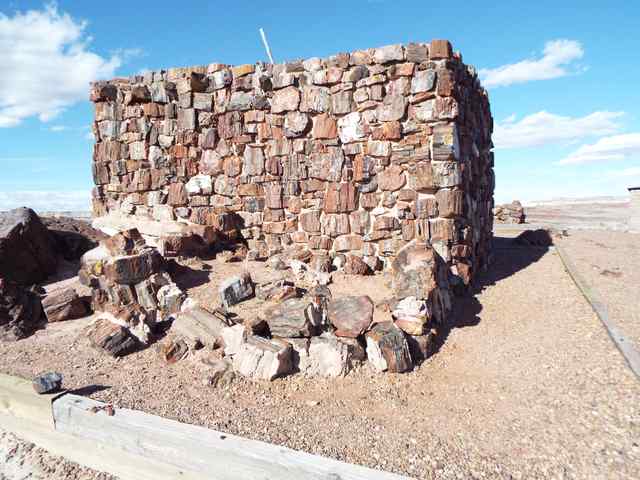
Before the walls rose again, workers at Agate House cleared away the loose petrified wood—and kept it. Beneath that material they traced foundations, found floors below the ground surface and uncovered firepits in two rooms. In the winter of 1933–34, archaeologist Cornelius B. Cosgrove Jr. supervised the excavation and reconstruction in Arizona’s Petrified Forest. The pieces set aside were intended for the walls. [1]
The original builders were Ancestral Puebloan people. The National Park Service places construction and occupation sometime between 1050 and 1300, not throughout that entire span. They made an eight-room pueblo with larger pieces of petrified wood, mud mortar and smaller pieces packed into the gaps. [1]
Where is this place?
Agate House, Petrified Forest National Park. This map locates the town or region, not a verified exact historic event site.
The distinction between an old settlement and its rebuilt walls was already explicit in 1940. Regional archaeologist Erik K. Reed described Agate House as partially rebuilt in 1934. His account placed it among a few local houses made from petrified wood; the material was also used for tools. It was not simply a modern novelty built to resemble a pueblo. [2]
That distinction has nevertheless needed explaining again. Introducing an annotated publication of Cosgrove’s report in 2026, the journal Lithodendron noted that doubts had been expressed about the structure’s Native origins. Its abstract describes reconstruction on the original pueblo footprint and explains why the excavation record was being published. [3]
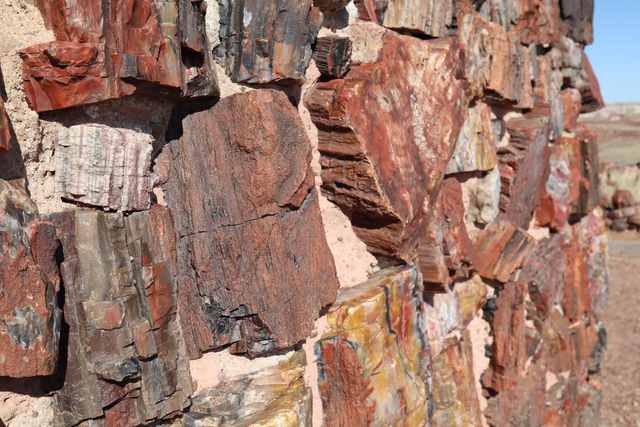
The park’s present interpretation adds an important qualification: using original material did not produce a wholly accurate replica. Nor does the lonely-looking hilltop represent an isolated building tradition; hundreds of similar petrified-wood structures have since been identified in the park. [1]
Agate House remains culturally significant to Hopi and Zuni people, the Park Service notes. Its public guidance is specific: do not climb or sit on the walls. [4]