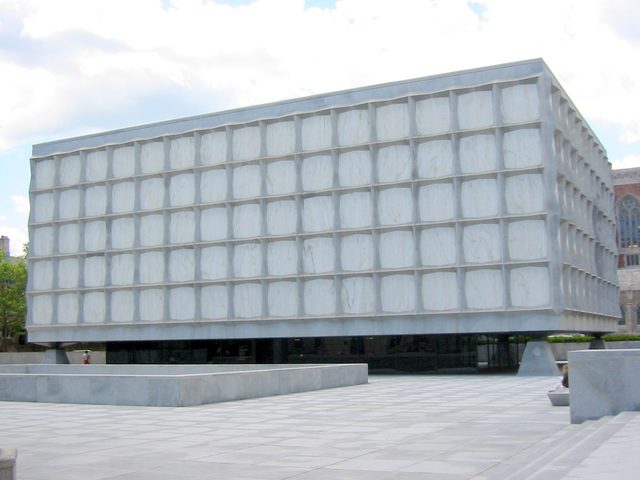
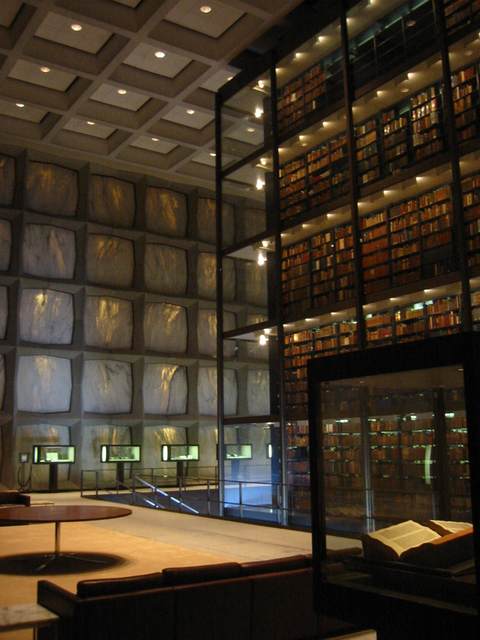
Before Yale’s Beinecke Library could renew its machinery, staff emptied its six-story glass book tower. The 180,000 volumes did not leave the premises: Yale’s August 2016 account says they moved to protected areas within the building during the renovation. Other collection material went to the university’s shelving facility in Hamden. [1]
The tower stood inside Gordon Bunshaft’s 1963 building in New Haven, behind a facade of granite and translucent marble. The library describes the marble panels as 1.25 inches thick. They soften incoming daylight and shield the collections from direct sun; the glowing stone does not eliminate the need to control the indoor climate. [2]
Where is this place?
Beinecke Rare Book and Manuscript Library, 121 Wall Street, New Haven. This map locates the town or region, not a verified exact historic event site.
Replacing that climate-control equipment involved a different kind of packing problem. Yale’s 2014 project announcement described room-sized air handlers and chillers in the sub-basement, with plans to dismantle them for removal through a shaft only three feet wide. Temporary air-handling units were planned outside on Wall Street to maintain conditions during the work. [3]
By August 2016, Yale reported that the sub-basement machinery had been replaced, alongside plumbing, electrical and other systems. The marble-and-granite exterior and glass tower had been refurbished rather than redesigned. HBRA Architects led the design work, with Newman Architects also involved. [1]
Readers had meanwhile used a temporary reading room in Sterling Memorial Library. The renovated Beinecke doubled its classrooms from two to four. One was planned as a laboratory where students could examine how books were made by working with ink, paper and printing—not only reading the finished pages. [1]