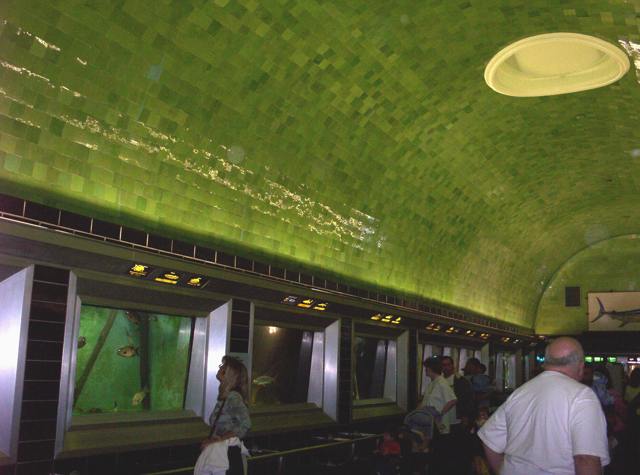
Look above the tanks in a 2005 photograph of Detroit’s Belle Isle Aquarium. The largest expanse of green belongs not to the water but to the ceiling. Small glass tiles turn the vault over the visitors into something like the inside of a wave. People stand dry beneath it, watching fish through separate windows.
This was an aquarium with two kinds of immersion. The animals needed actual water; the audience was offered an architectural suggestion of it. The Detroit Historical Society describes the sea-green finish as a way to create an underwater feeling. It also relays the Belle Isle Conservancy’s account of Albert Kahn’s intention: fish displayed along the walls like works in a gallery. The building opened in 1904. [1]
Where is this place?
Belle Isle Aquarium, Detroit, Michigan — geographic context, not a current entrance or construction-access guide. This map locates the town or region, not a verified exact historic event site.
A gallery you could send through the post
A Detroit Publishing Company postcard makes that arrangement unusually clear. Visitors occupy a broad central passage, while illuminated rectangles run down both sides. The ceiling continues over everyone, joining the separate exhibits into one room. Its printed number, 11664, matches a postcard catalogued by the Detroit Historical Society with a July 1909 postmark. [2] The image reproduced here is the Commons-hosted Newberry Library copy, not the physical card in that Detroit catalogue. [5]
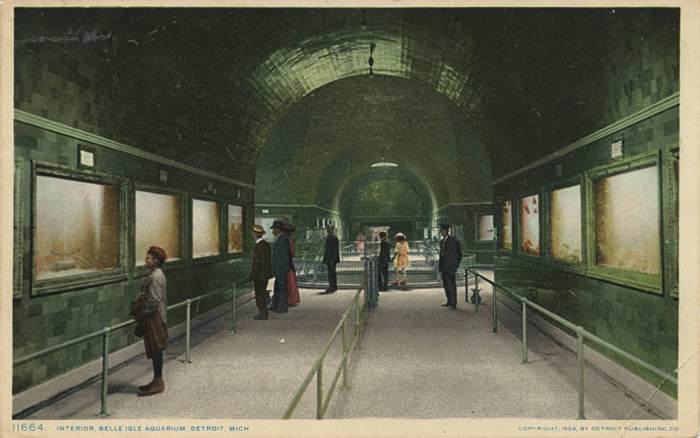
The card is a coloured printed image, not a trustworthy paint chart. Nor does its date establish when the camera exposure was made. What it does offer is an early public image of the aquarium: people looking sideways at tanks, enclosed by a larger spectacle overhead. The room itself was part of what Detroit sent away as a souvenir.
Looking old took new work
Keeping that experience did not mean leaving every component alone. The historical society’s account records changes to tank construction, lighting and filtration during the 1950s renovation. Much later, two skylights were restored in 2014, with pendant lighting intended to recover something of the early interior’s appearance. A familiar-looking room could therefore contain several generations of decisions. [1]
The aquarium closed in 2005 and reopened in 2012. In a December 2016 interview with Michigan Radio, general manager Fred Huebener credited volunteers with sustaining the campaign and helping restore the building. The accompanying report identified volunteer cleaning of the glass-tile ceiling. It also recorded his account of the reopened collection growing from five tanks in 2012 to 43 by the interview. Those are historical figures, not a current inventory. [3]
Cleaning the surface people remember was one part of recovery. Rebuilding the living collection was another. An aquarium cannot be preserved quite like an empty period room: its exhibits require care, not simply protection from change.
That distinction remains visible in the Conservancy’s own description of a $10 million modernization project, which pairs historic preservation with upgrades to life-support systems. This is the operator’s project account, not an independent assessment of the equipment or animal welfare. [4]
The green vault gives visitors a little of the drama of going underwater without asking them to leave the floor. Maintaining that illusion and maintaining the water are different jobs. Belle Isle’s history becomes more interesting when both stay in view.