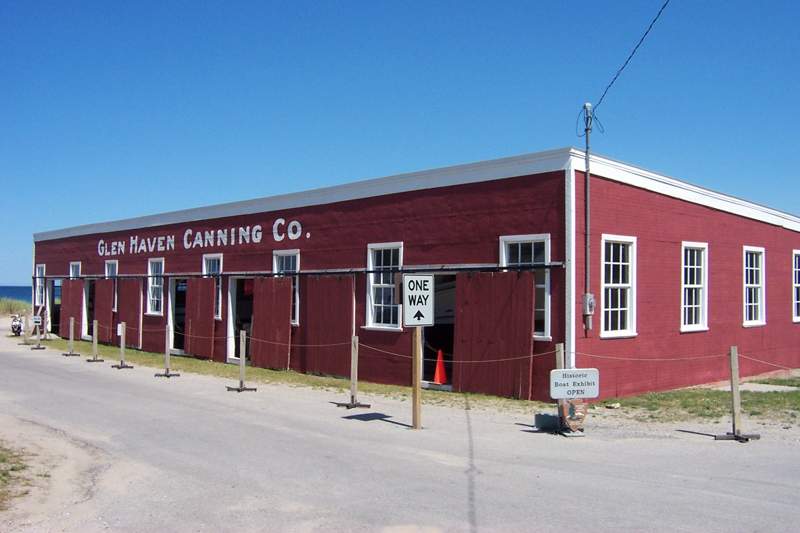
At Glen Haven, Michigan, a restoration project had two different problems beneath its feet. The old cannery needed a stronger foundation. A nearby dune had become too firmly held in place. [1]
A building that changed its cargo
The National Park Service’s account of the cannery begins with a warehouse: a building used to hold things waiting to be shipped. D. H. Day adapted it for fruit processing as the area’s economy diversified beyond lumber. The Glen Haven Canning Company packed cherries, raspberries and peaches for markets in Great Lakes cities. The building later became a museum of boats. [2]
Where is this place?
Glen Haven Cannery and Boat Museum, Michigan — building location, not a mapped restoration boundary. This map locates the town or region, not a verified exact historic event site.
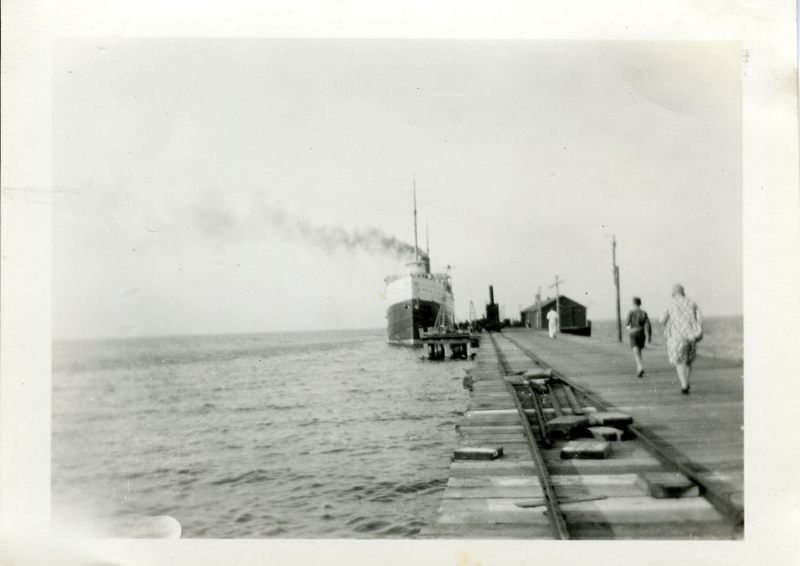
The surviving building thus carries more than one waterfront history. Its name recalls fruit; its exhibits recall vessels. The historic dock photograph reproduced here shows another part of that working shore, not the restoration project itself.
In July 2010, the park announced that the entire cannery would be lifted so its failing original concrete foundation could be replaced. The work formed part of a federally funded rehabilitation of the historic village. [1]
A separate preservation organization recorded the result. In its Fall 2010 newsletter, Preserve Historic Sleeping Bear included the cannery’s floor and foundation repair in a list of work completed by the park during the fiscal year ending September 30. The same report warned against mistaking a large year of repairs for an end to the need for maintenance. [3]
Grass was not automatically protection
Alongside the building work, the park planned to remove aggressive, non-native marram grass planted in the 1980s. Its dense roots, the 2010 announcement explained, were artificially stabilizing the foredune and crowding native plants, including Pitcher’s thistle. The replacement planting would use native grass propagated by a local nursery from stock gathered within the lakeshore. [1]
This was not a proposal to strip the shore of every plant. Michigan Natural Features Inventory, part of Michigan State University Extension, describes open dunes as a changing system in which wind, water, sand and vegetation act together. Native marram grass itself helps sand accumulate and allows other plants to establish. Yet invasive plants can also stabilize dunes in ways that eliminate habitat for species dependent on shifting sand. [4]
Too much disturbance is no answer either. The same ecological account warns that vehicles and excessive recreational use can destroy vegetation and magnify erosion. The distinction is between maintaining a living dune system and treating every patch of bare sand as a defect—or an invitation to walk anywhere.
Two jobs, not one finish line
The park’s 2011 visitor guide reported that the cannery had reopened with a new foundation, fresh paint and an entrance plaza. Its superintendent also asked people to use the newly established beach walkways instead of creating multiple paths across the dunes. Protecting the setting involved directing people as well as changing plants. [5]
The guide is less tidy about the planting timetable. Its opening message describes native replacement as completed, while the Glen Haven project item on page 10 still describes planting as work for that season. The latter confirms that the non-native grass had been removed the previous year. These accounts establish a restoration effort, not a precise planting completion date or a measured recovery of the thistle population. [5]
Glen Haven’s paired repairs make preservation harder to reduce to a single instruction. A museum building needed dependable support. The landscape beside it needed care for processes that include movement. Keeping the place did not mean making everything stay still.