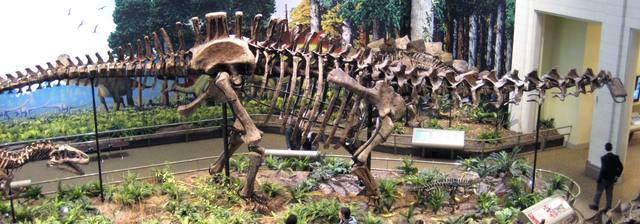
In Pittsburgh, giving a dinosaur a new head did not mean finding a new fossil. The skull behind the Carnegie Museum of Natural History’s 1979 correction had been excavated in 1910, close to the skeleton it would eventually help explain. The difficult part was deciding what that proximity meant. [1]
The museum’s Apatosaurus louisae had gone on display in 1915 without a head. A narrow skull from the same Utah quarry was a candidate, but it had not been found attached to the neck. A nearby bone was evidence to consider, not a label conveniently left by the animal. [1, 2]
Where is this place?
Carnegie Museum of Natural History, 4400 Forbes Avenue, Pittsburgh — museum context, not the Utah excavation site. This map locates the town or region, not a verified exact historic event site.
A convincing head is not necessarily the right one
During the 1930s, the mount received a cast based on Camarasaurus, another long-necked dinosaur. National Park Service paleontologist ReBecca Hunt-Foster identifies the model as skull CM 12020, collected at the Carnegie Quarry in 1915–16. That catalogue number matters: this was not merely an artist’s vague idea of a dinosaur face. A real fossil supplied a persuasive-looking answer for the wrong kind of animal. [3]
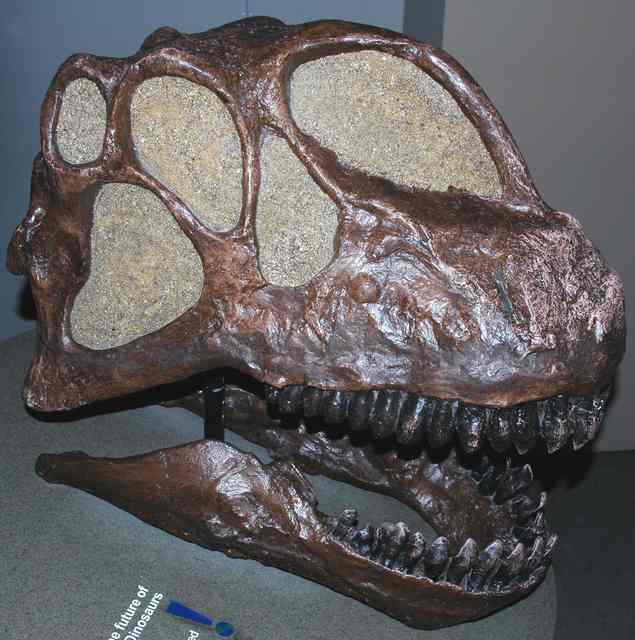
The alternative skull, CM 11162, looked more like that of Diplodocus. Museum director William J. Holland and collector Earl Douglass had suspected its connection to Apatosaurus. According to historian and museum research associate Keith M. Parsons, Holland defended that identification in 1914, yet left the display headless. Parsons could not establish who later decided to install the Camarasaurus cast. The gap in the record should remain a gap, rather than become a story about an identifiable villain. [4]
In the 1970s, John S. McIntosh reconsidered the evidence, including Douglass’s correspondence. His work with Carnegie paleontologist David Berman compared the animals’ anatomy and supported the narrower head. Their 1978 study made the case for CM 11162; the museum changed the mount the following year. [4]
The replacement was a cast, too. Correcting the identification did not require suspending the original, delicate skull at the end of the neck. A replica could make a scientific conclusion visible while the fossil remained a separate object to protect and study. [2, 4]
Even the correction has a history to check
The broad sequence is clearer than one date within it. Carnegie’s online account and the National Park Service give 1932 for the wrong head’s installation. Parsons’s 1997 account gives 1934. [1–4]
A 2025 research paper on Carnegie’s neighbouring Diplodocus mount returns to this discrepancy. Michael P. Taylor and colleagues point to a 1934 museum report about casts made by Serafino Agostini. If the Apatosaurus head was that cast, they note, the earlier date cannot be right. Their qualification matters: it raises a documentary problem without pretending to settle the identity of the cast. [5]
Pittsburgh’s dinosaur therefore offers two kinds of unfinished work. Researchers had to ask which skull belonged to which animal; historians still have details to establish about how the museum assembled its answer. The photographs here distinguish the Apatosaurus mount from the Camarasaurus skull used as the earlier model. They are not pictures of the 1979 exchange. [3]
What changed in the hall was conspicuous. What made that change possible was less theatrical: a retained specimen, old correspondence and a willingness to examine an earlier interpretation again.