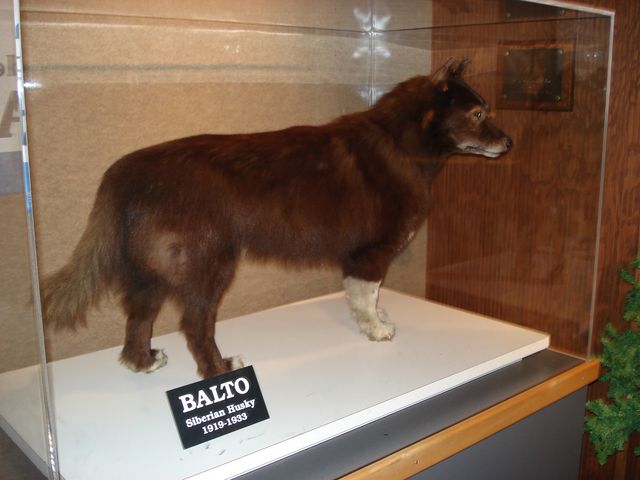
In Luke Scarano’s photograph of an earlier Cleveland Museum of Natural History display, Balto stands in a glass case above a small nameplate. Beneath his name are two familiar words: “Siberian Husky.”
In 2023, scientists used DNA from his remains to investigate a population of working sled dogs that did not fit neatly into today’s breed categories. [1, 2]
Where is this place?
Cleveland Museum of Natural History, Ohio, USA — museum context, not restricted collections or sampling access. This map locates the town or region, not a verified exact historic event site.
How an Alaskan sled dog became a Cleveland specimen
Balto led the final team in the 1925 relay that carried diphtheria antitoxin to Nome. He did not make the entire journey alone: the museum’s account credits 20 mushers and more than 150 dogs. [1]
His route to Cleveland came later. After a touring career, Balto and several teammates were being exhibited in poor conditions in Los Angeles. George Kimble, a visiting Cleveland businessman, organised a campaign to buy them. Donations from residents and businesses raised $1,500 in ten days, according to the museum. [1]
The dogs arrived in Cleveland in March 1927 and lived at Brookside Zoo. After Balto died in 1933, his taxidermied remains went on display at the natural history museum. Decades later, that same institution could provide tissue for a different kind of inquiry. [1, 2]
The question was not simply “Which breeds?”
UC Santa Cruz’s account of the research describes comparisons with 682 genomes from modern dogs and wolves, alongside the Zoonomia alignment of 240 mammalian genomes. Balto shared ancestry with several living dog lineages, but only part of it with the modern Siberian husky breed. The researchers also identified genetic variants that might have helped his working population cope with its environment. [2]
In a Science Friday interview, coauthor Beth Shapiro explained that asking which of today’s breeds were “in” Balto gets the historical relationship backwards. His population preceded the formation of the modern Siberian husky breed; related ancestry continued into later dog populations. [3]
Lead researcher Katie Moon described taking a small piece of skin from Balto’s underside. Shapiro explained that the surviving DNA was fragmented, requiring techniques suited to old material. [3]
Possible genetic adaptations do not establish why an individual dog succeeded at a particular moment during the relay.
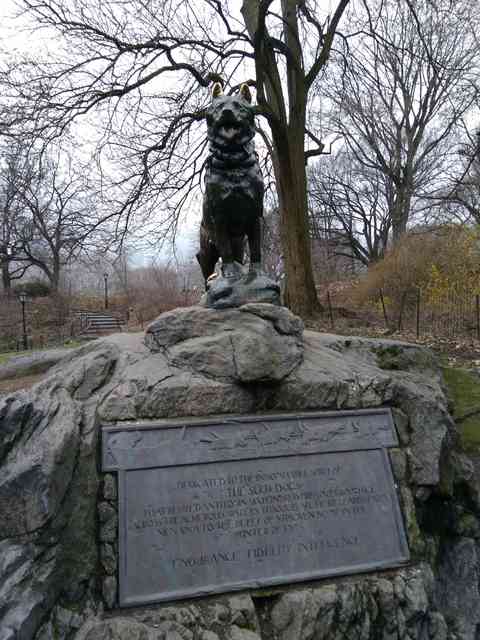
The museum lists Balto among the specimens in its Visitor Hall. [4] His bronze memorial remains in New York’s Central Park, where it was unveiled in 1925. [5]