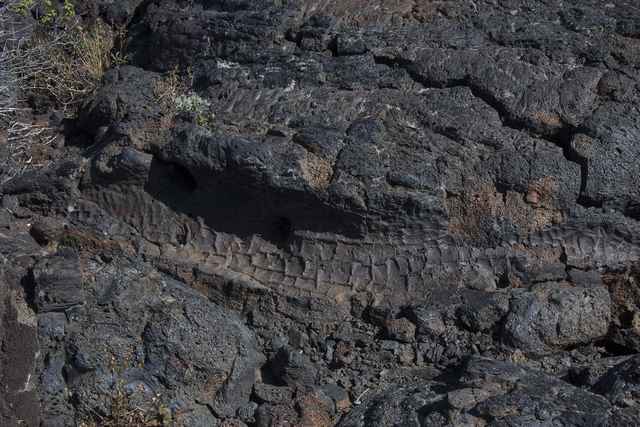
The long hollow in James Tolbert’s 2013 photograph has the shape and surface texture of a fallen trunk. But the object carrying that texture is dark volcanic rock. At Idaho’s Craters of the Moon, a tree can leave a remarkably legible outline without leaving a tree for a botanist to identify. The empty space is part of the evidence—not a piece missing from a reconstructed exhibit. [1, 2]
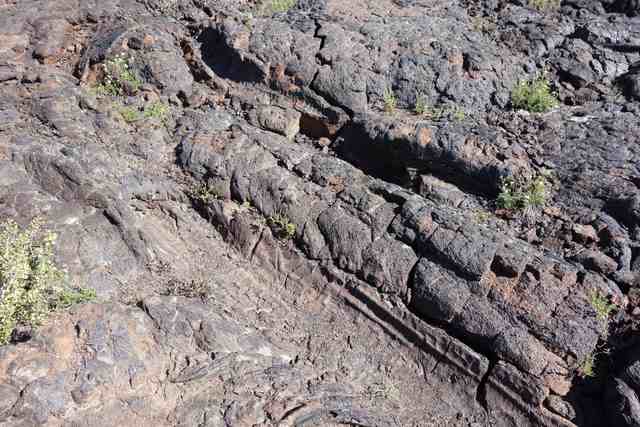
The Tree Molds Trail reaches the edge of the Blue Dragon Flow, where lava engulfed trees, knocking some down while others remained upright. The resulting molds can run horizontally through the rock or descend vertically into it. A Park Service geology guide places the flow roughly 2,100 years before the present. These are traces of vegetation encountered by an eruption, not trees subsequently carved into the lava. [1, 3]
Where is this place?
Tree Molds Trail, Craters of the Moon, Idaho — site context, not current trail conditions or off-trail directions. This map locates the town or region, not a verified exact historic event site.
Their formation depended on more than heat. A Park Service account adapted from a 2012 scientific inventory explains that moisture escaping from an engulfed tree helps cool the lava touching it. A crust can take an impression before the tree is consumed or decays. What survives need not be mineral-replaced wood: it can be the space around wood that no longer occupies it. [4]
The apparent detail invites a tempting next step: name the tree. The sources are more complicated. The Park Service’s geology guide describes fine bark impressions, while the monument’s proposed management plan says its molds generally record cracked, partly burned wood, without the textures needed to identify species. Those descriptions should not be silently turned into a confident label for the tree in a photograph. A recognisable trunk shape and a diagnostic botanical feature are different things. [1, 2]
Something less photogenic can answer another question. The park’s fossil account reports that charcoal found around these features has been used to date lava flows. The scientific-inventory account explains how such material helps establish an eruption sequence. That does not mean the pictured mold supplied a particular laboratory sample, or that its visible texture gives an exact eruption date. It means an impression and a surviving fragment can carry different kinds of information. [4, 5]
Even the rock record is not permanent. The geology guide describes tree molds as fragile surface features that weather and erode. Tolbert’s close view and the Park Service’s wider 2013 photograph preserve views of the marks, not a complete inventory of the vanished vegetation. The landscape offers an unusual kind of recognition: we can see where a tree was, while still having to ask what, exactly, the evidence lets us know. [1]