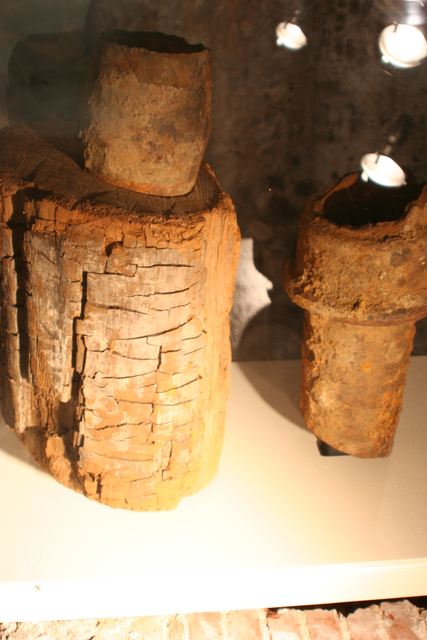
A wooden water main in an earlier photograph of Philadelphia’s Fairmount Water Works shows deep cracks. Beside it sit sections of old metal pipe. They make water infrastructure look tangible: something to bore, connect, replace or repair.
The research described at the site’s mussel hatchery involves another kind of connection. To grow certain freshwater mussels, scientists first have to find fish that can carry their larvae. The fish are not an incidental part of the tank’s scenery. Their suitability can determine whether the next generation of mussels gets started. [1]
Where is this place?
Fairmount Water Works Interpretive Center, Philadelphia, Pennsylvania — named-site context, not restricted lab or fish-collection access. This map locates the town or region, not a verified exact historic event site.
A different problem inside an old water works
Fairmount’s nineteenth-century machinery moved water from the Schuylkill River into Philadelphia’s supply system, first with steam power and later with waterwheels and turbines. [2] The demonstration hatchery’s aim is different: raising native mussels, studying propagation and helping rebuild populations in regional waterways. [1]
Many freshwater mussels spend an early stage attached to a suitable fish host. That relationship creates a practical problem in a laboratory: obtaining a fish is not the same as keeping it alive and suitable throughout the process. [1, 3]
In a May 2024 account, Philadelphia Water Department scientist Lance Butler described collecting landlocked alewife fish from Blue Marsh Reservoir for the hatchery. The collection and transport were time-consuming, and these sensitive fish could suffer substantial mortality. A familiar host in the wild was not necessarily an easy one to work with in captivity. [3]
That April, the Water Department and Partnership for the Delaware Estuary tried hybrid striped bass instead. The hatchery’s account reported more than 12,000 juvenile alewife floater mussels from 60 hybrid striped bass—roughly 200 per host. The point was not merely a larger total. A different host offered a possible way around one of the constraints on producing mussels. [3]
This was a reported hatchery result, not evidence that hybrid bass should replace fish populations in the river. Nor is a fish stage unavoidable in every laboratory method. The Water Department had already described successful in-vitro propagation of two native mussels, bypassing the host-fish step. [1]

Producing juveniles is not the finish line
The work continues after young mussels leave the hatchery. In a 2021 account from Audubon’s Discovery Center, educator Bria Wimberly described a nursery at Strawberry Mansion Reservoir where staff and volunteers measured mussels monthly, watching their growth and looking for abnormalities. The growing animals needed monitoring, not just release from a tank. [4]
Fairmount’s October 2025 update reported more than 100,000 juvenile mussels propagated to that point. It also explained that many went into laboratory research, trials of grow-out sites and education programmes. That cumulative production figure was not a count of mussels already established in wild river beds. [5]
The old pipe sections show a direct physical route for water. The hatchery’s route is less straightforward: host choice, juvenile development, growing sites and checks on survival. Fairmount remains a place for thinking about what water infrastructure can do—but its living experiments cannot be judged by a production number alone.