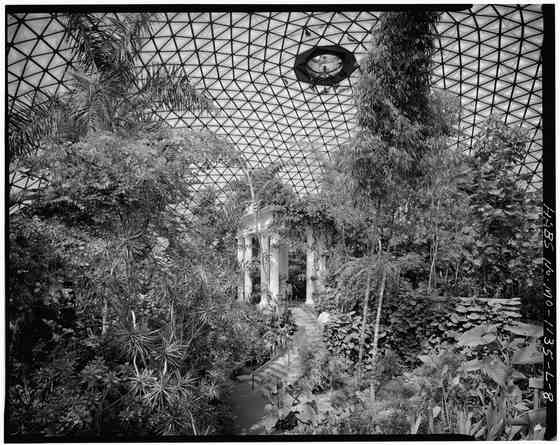
The new glass arrived from outside. During the Climatron’s reglazing in 1988, a crane lifted panes towards the dome while workers above coordinated with colleagues on scissor lifts inside. They were not allowed to use the old aluminium frame to hoist the glass. [1]
The greenhouse at the Missouri Botanical Garden in St Louis had opened in 1960. Director Frits Went had wanted a place for experiments as well as plant displays, using different controlled climates under one roof. The Garden’s archive records the difficulty of establishing and maintaining those microclimates: the display function prevailed. [2]
Where is this place?
Climatron, Missouri Botanical Garden. This map locates the town or region, not a verified exact historic event site.
One part of that display, Misty Ridge, linked the upper and lower levels. A 1962 Garden Club of America award helped complete its funding. The club’s account lists begonias, African violets, tree ferns and cherimoya among the plants grown there. [3]
By the later refit, the original Plexiglas had become scratched and internally fractured. Writing in Architecture in March 1989, Allen Freeman reported that light transmission had fallen by about half. The replacement was not simply glass hung where plastic had been. A freestanding glass dome, anchored at five piers, took over the enclosure; the old frame remained. [1]
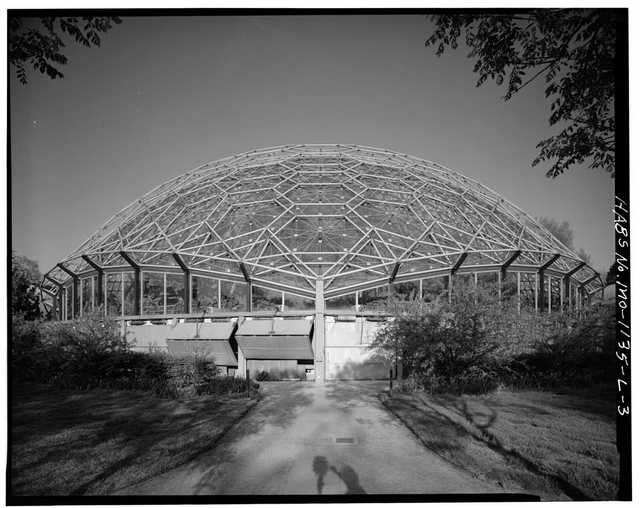
Architect Jim Morgan explained why the hoisting method mattered. The existing structure was designed for distributed loads, not the concentrated loading that lifting glass could impose. Larger panes also meant fewer glazing bars—and less shade. The last pane went in on 26 October 1988, protecting the plants against freezing. [1]
The interior changed too. When the greenhouse reopened in 1990, Misty Ridge was gone. In the Garden Club’s account, ferns and cycads occupy its former area. [3]