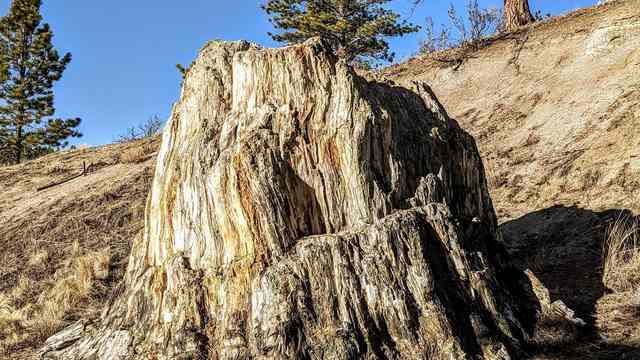
The Big Stump at Colorado’s Florissant Fossil Beds carries a conspicuous trace of human ambition: broken saw blades embedded in petrified wood. The National Park Service’s account connects them to a failed attempt to cut the stump into transportable pieces for Chicago’s 1893 World’s Fair. The fossil stayed. The marks of trying to move it stayed too. [1]
But keeping a stone tree in place is not the same as keeping it together. At Florissant, the work of preservation has included matching detached fragments to their old positions—and waiting for the weather to let people put them back. [2][4]
Where is this place?
Florissant Fossil Beds National Monument, Teller County, Colorado, USA — park context for two separate fossil stumps. This map locates the town or region, not a verified exact historic event site.
Burial preserved them. Excavation exposed them.
The park’s 2023 geological bulletin places the ancient forest about 34 million years in the past. A volcanic mudflow buried the lower trunks, while the treetops and roots decayed or broke away. Mineral-bearing water deposited silica within the wood. What survived was stone that retained details of the trees, not wood made immune to damage. [2]
Later excavation introduced a different set of stresses. The same bulletin describes commercial operators uncovering stumps in the 1920s, including the use of dynamite that likely contributed to cracks in specimens near the visitor center. Water can enter those cracks, freeze and expand. The injury does not have to end when the digging stops. [2]
A fragment needed an address
At another fossil, Stump P-47, monitoring became part of the repair work. A 2022 Park Service account describes a nearby weather station measuring air temperature, temperatures at the stump’s surface and inside cracks, and moisture around it. P-47 is not the Big Stump: the two photographs here show different specimens and different parts of the conservation story. [3]
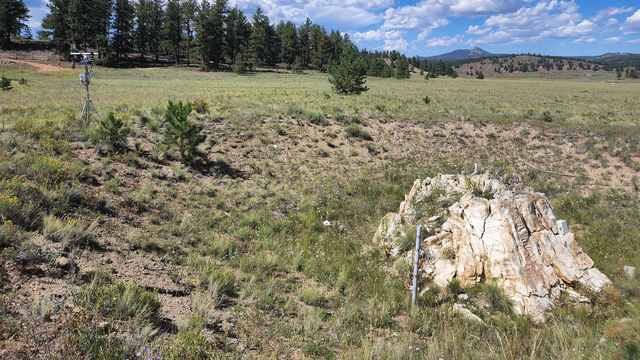
Research fellow Carly Adler’s account supplies a closer view of work at P-47 in June 2021. Working with Caitlin Livesey and Isabel Schneider, she used earlier photographs to help identify loose pieces and losses. Numbered, color-coded markings paired fragments with the places they belonged. Measurement and photography came before reattachment. [4]
Adler reports that the team reattached 141 fragments. She also records an obstacle no catalog number could solve: rain and hail left the stump too damp to work on. An alternative workspace in a yurt helped, but the outdoor fossil still set conditions for the work. Her account records that season’s achievement, not a guarantee that deterioration had ended. [4]
The contrast is smaller and stranger than a simple rescue story. At the Big Stump, an effort to make the fossil travel left metal behind. At P-47, conservators worked to keep small pieces in their right places. Florissant’s stone trees have survived deep time; that does not mean their exposed surfaces can be left to look after themselves. [1][3][4]