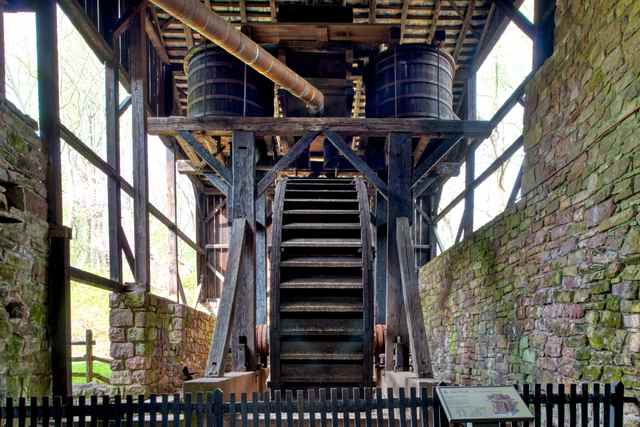
The 2005–06 reconstruction of Hopewell Furnace’s waterwheel included an unusual choice: custom metal fittings were left unprotected against rust. The contractor expected them to stain with age, while proposing a longer-lasting wood for the buckets. [1]
At this former ironmaking community near Elverson, Pennsylvania, the wheel’s job was to help produce a blast of air. Water turned the wheel; the machinery drove pistons inside two large wooden blowing tubs. Air passed through a receiving box and a pipe toward the furnace. The barrels above the wheel in the National Park Service’s photograph are therefore not storage containers. They belong to the system that helped the furnace burn hot enough to make iron. [2]
Where is this place?
Hopewell Furnace National Historic Site, Pennsylvania — general public historic-site location, not an exact photo viewpoint or surveyed wheelhouse point. This map locates the town or region, not a verified exact historic event site.
A wheel with more than one replacement date
An undated historical photograph on the park’s water-wheel page shows a much less complete assembly: a damaged roof, exposed timbers and a wheel missing much of its outer structure. NPS identifies it as the wheel built in 1879. That is a construction date, not a date for the photograph. The image cannot tell us exactly when the deterioration occurred, but it does make one distinction plain: preserving the arrangement was not simply a matter of keeping an intact machine indoors. [2]
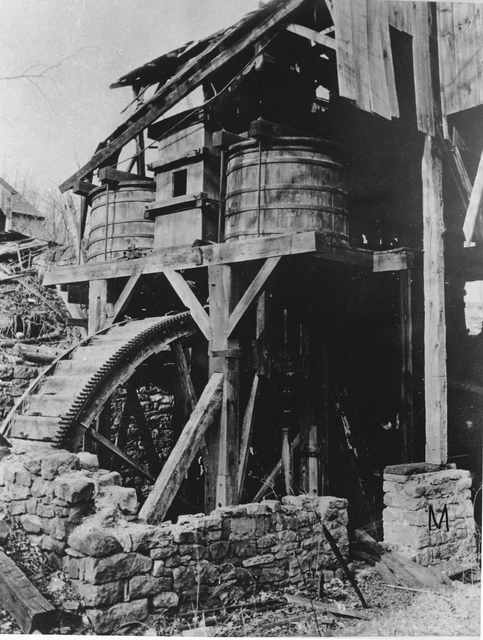
The furnace ceased operating in 1883. In the twentieth century, recreating its wheel became a preservation task. NPS dates one reconstruction to 1949–52 and another dedication to 1988. The 1952 wheel had become unstable in motion; by 2003, a further replacement was judged necessary. The next dedication took place on 5 August 2006. A familiar outline could conceal several generations of work. [2]
New material, deliberately ageing metal
Stan Graton II’s firm, 3-G Construction of Holderness, New Hampshire, describes dismantling the wheel and copying parts at its shop. Its account records white oak rims and plans for cypress buckets rather than pine. Written during reconstruction, it documents choices—not a subsequent durability test. [1]
The company described unplated hardware approximating earlier forms. It quoted Graton: “They want it to rust and stain as it ages.” That explanation concerns the finish. It does not establish that every rusty fitting at Hopewell is harmless, or that deterioration elsewhere should be ignored. [1]
Nor did the wheel’s dedication finish the work around it. The company’s portfolio separately lists a 2010 Hopewell project to replicate the flume carrying water to the wheel and rehabilitate the blowing tubs. The wheel, its water supply and its air machinery could require attention on different schedules. Those project records do not establish their condition today. [3]
Water was both the wheel’s means of working and a source of wear. NPS notes that its wooden buckets need periodic replacement. Read alongside the contractor’s account, that makes the reconstruction more interesting than a choice between old and new. Some components were selected with longer service in mind; some metal was expected to acquire visible age. The surviving form depended on people deciding which kinds of change to resist—and which to allow. [1][2]