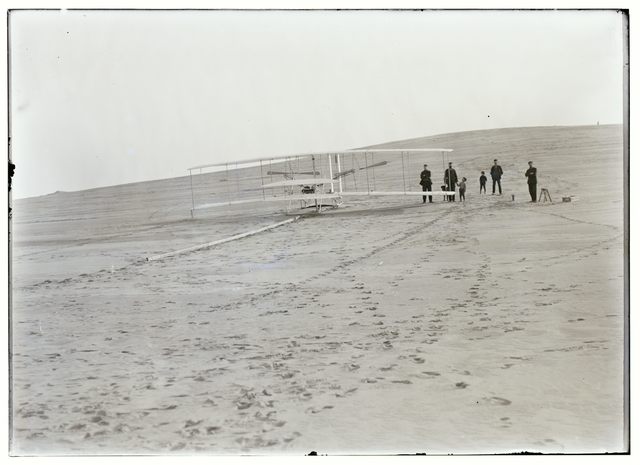
Before the masons arrived at Kill Devil Hill, the Coast Guard and local residents began planting it. In 1928 they put shrubs and sand grass around the base and up the slopes of the dune chosen for a Wright brothers monument. The ground beneath the proposed memorial had been moving. [1]
The National Park Service’s 2020 environmental assessment puts the hill’s southwestward shift since the Wright era at roughly 300 to 600 feet. Wind had altered the surrounding landscape enough to make locating the exact spot of the first powered takeoff difficult, too. The First Flight Marker, dedicated in 1928, marked an approximate location. [2]
Where is this place?
Big Kill Devil Hill, Wright Brothers National Memorial. This map locates the town or region, not a verified exact historic event site.
For glider experiments, the dune had offered something useful: elevation above a broad stretch of soft sand. The brothers carried their machines up this and neighbouring hills. For a heavy granite monument, drifting sand presented a different problem. A committee investigating the site in 1928 found moist, compacted sand within the hill and concluded that planting could secure it. [1][4]
More stabilization followed. The NPS account dates its completion to 1931, before construction began that December. A wire fence around the base was part of the job, keeping tourists, souvenir collectors and wild hogs from damaging the site. The monument was finished in November 1932: a 60-foot shaft above a dune now held by vegetation. [1][3]
Vegetation later became something to manage in the other direction. A 1947 master plan proposed thinning brush and other growth to bring the setting closer to its historic appearance. Later park planners inherited a planted memorial as well as the site of the Wrights’ experiments. [1][2]
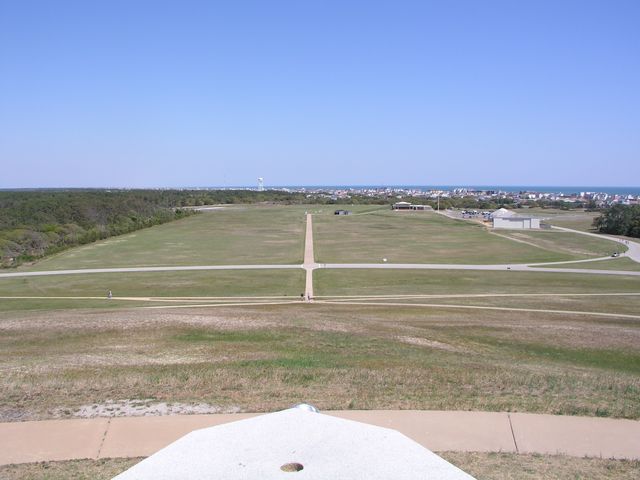
The 2020 assessment explicitly describes a designed commemorative landscape, not a preservation of the original scene. Its historic features include the hill, the curving paths up to the monument, and the spatial relationship between that monument and the First Flight Marker. The planted ground is part of the place’s history, alongside the sand on which the Wrights worked. [2]